

While numerous issues between the states of Sudan and South Sudan remain unresolved, questions regarding citizenship rights for southerners in the North and northerners in the South have had some of the most direct and immediate effects on the people of these countries. As Enough has previously reported, the lack of agreement on citizenship has not only led to a degree of uncertainty, prompting many southerners to seek safety in the South, but has also created space for the northern government to place restrictions on southerners’ ability to work and live in the North, despite the fact that many have lived there for decades.
This week, Sudan Votes published a piece by Hassan Barakya that highlighted how this issue is currently playing out for one particularly vulnerable group of people: the Dinka Ngok in the contentious border region of Abyei. Barakya writes:
Now that South Sudan is independent, the Ngok Dinka are in legal limbo. While their stated loyalty has always been with the south, the geographical region they inhabit along with migratory groups officially belongs to the north. So it came as a surprise when the Sudanese National Assembly announced it would withdraw the citizenship of Abyei’s Ngok Dinka, only to backpedal on its decision last month.
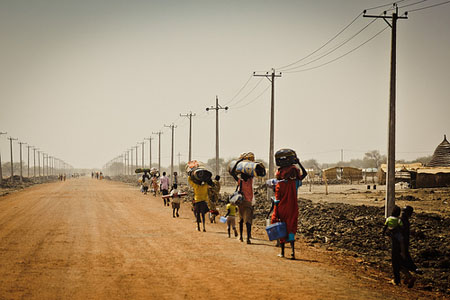
This kind of volatility likely does little to instill confidence among the Dinka Ngok people that their right to live in the Abyei area is secure. Add to this the fact that around 110,000 people, mostly Dinka Ngok, are still displaced from the area due to an invasion by Sudanese Armed Forces in May, and that the area continues to hold tremendous political significance – it’s hard not to interpret this as some sort of strategy by the government to discourage Dinka Ngok resettlement. Clearly this is an issue that the international community will need to continue to watch.
Photo: People fled south from Abyei when SAF forces invaded in May (Enough Project/Tim Freccia)