
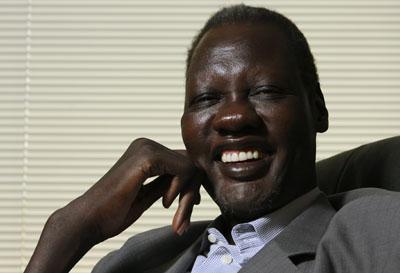
In Memory of Manute Bol: A Giant Among Us


The Save Darfur Coalition's Alex Meixner wrote this post, which originally appeared on SDC's blog.

The first time I saw Manute Bol in person, I stared in something like disbelief. Bol and his Golden State Warriors were in L.A. to play the defending champion Lakers in the late 1980s, and even amid nine other professional basketball players, he literally stood out, easily a head taller than anyone else on the floor. And yet his decidedly un-Shaq-like physique made him seem somehow as vulnerable as he was imposing. In short, he was something of a wonder to behold, and his incongruousness with even his American counterparts gave 10-year-old me the briefest sense that the world was a very big place indeed.

In the following years, while I (like so many other Americans) saw my awareness of Sudan slowly grow from non-existent to minor, Bol continued to be perhaps the most-recognizable representative and benefactor of the millions of southern Sudanese who were living through a seemingly never-ending and atrocity-laden civil war. He made a fortune blocking shots in the NBA, and gave almost all of it away to help folks back home who needed it more.  He offered up his body and what some would mistake for his pride by agreeing to be paraded out in front of gawking crowds in one-time fast-cash gimmicks. He laced up a pair of skates for a minor league hockey team (as you might guess, ice hockey isn’t a big pastime in Sudan) and soundly beat William “the Refrigerator” Perry in a celebrity boxing match.

Then, in 2004, while asleep in the back seat of a cab on the way home from the airport, his drunken driver lost control and crashed into the guardrail, killing himself and throwing Manute from the car. It would take him months to recover from a broken neck and other injuries, which combined with worsening rheumatism and a rare skin disease to make life even harder for the one-time athlete who had famously killed a lion with a spear while still in his youth and played 10 seasons in the NBA.

It was a bit less than two years after the crash that I once again found myself staring with some disbelief at Manute as he climbed out of a car into which I wouldn’t have thought he possibly could have fit just prior to Save Darfur’s rally on the National Mall in Washington, DC on April 30, 2006.  To anyone armed with knowledge of his personal story and current circumstances, it was clear that his commitment to helping the people of Sudan was simply incredible.  Despite his chronic ailments and recent injuries, despite the fact that he had had every opportunity to put himself first and walk off into a comfortable retirement, and perhaps most remarkably despite the fact that Sudanese President al-Bashir had for decades used Darfurian draftees to fight Bol’s tribesmen in southern Sudan (in much the same way Bashir later used members of these same tribes again by turning them into Janjaweed militias and setting them against their fellow Darfurians), this unassuming giant (and it’s not easy to pull off “unassuming” when you’re 7’7”) was once again giving all that he had left – his voice – to help Darfurian victims of the Sudanese government’s brutality.  Throughout what were the last years of his life, his commitment never wavered.

Manute Bol was truly a walking, talking, larger-than-life object lesson in how to put God’s gifts to their best use. While he will likely be remembered here in America primarily for blocking shots and hitting improbable three-pointers, his true legacy is much bigger than that.

My colleague Niemat Ahmadi from Kabkabiya, Darfur in western Sudan says it best:

“He has become our voice, the voice of all the oppressed in Sudan. He was the pride of our country and will remain so. We are saddened that he has left before seeing the long awaited dream of every southerner in Sudan for the 2011 referendum, yet his light will continue to shine among us. We are all indebted to his courage, resolve and commitment that has inspired us and we will continue carry on the mission that he has started.”

Manute Bol died on Saturday, June 19, 2010 from acute kidney failure brought on by complications arising from his skin disorder, Stevens–Johnson syndrome. He was 47.

Manute Bol was a great defensive player whom I grew up watching. After basketball he proved to be even a greater person of the court. Super Ena lotto

Manute Bol was a great defensive player whom I grew up watching. After basketball he proved to be even a greater person of the court. Superena Italian lottery

Manute Bol was a great defensive player whom I grew up watching. After basketball he proved to be even a greater person of the court. Superena Italian lottery

Sen. Sam Brownback remembers the late Manute Bol on the Senate floor Tuesday, describing him as both a hero and a humanitarian. (AP)

Sports stars often make headlines with spectacular misconduct, and they don’t use their celebrity enough to make the world a better place. But every now and then, along comes a star as gifted ethically as athletically — and I’m thinking now of one of the greatest basketball players ever.
Fred R. Conrad/The New York Times

Nicholas D. Kristof More Photos »
On the Ground

Nicholas Kristof addresses reader feedback and posts short takes from his travels.
Go to Blog »
Go to Columnist Page »
Multimedia
Slide Show
A Tribute to Manute Bol
Related

*
Manute Bol, N.B.A. Player and Activist, Dies at 47 (June 20, 2010)

Readers' Comments

Share your thoughts.

* Post a Comment »

Certainly not one of the best shooters, for he averaged only 2.6 points a game. But Manute Bol, at more than 7 feet 6 inches tall, was a moral giant who was unsurpassed in leveraging his fame on behalf of the neediest people on earth.

Bol died on Saturday from a noxious mix of ailments, exacerbated by his insistence on working in Sudan to build schools and forestall a new civil war. Bol’s great dream was to build 41 new schools across Sudan (he admired the first President Bush, hence the No. 41).

It’s a lofty dream, particularly because he is no longer around to speak at fund-raisers. It’s almost as inconceivable as the dream he had when he was an African cattle-herder aspiring to play in the N.B.A. — and this too can be a slam-dunk, posthumously, if his fans help out.

If each admirer chipped in the cost of a ticket to just one game, if each of his former teams agreed to match donations, if a few current and former N.B.A. stars agreed to stand in for Bol at fund-raisers, why then schools would sprout all across Sudan.

The first of Bol’s 41 schools is now approaching completion in his childhood village, said Tom Prichard, executive director of Sudan Sunrise, the charity that Bol used to build his schools. Forty to go.

Bol grew up herding cattle. Twice he ran away in hopes of attending school, but he never got much formal education. He moved to the United States and played in the N.B.A. from 1985 to 1995, setting a rookie record for blocking shots. He was a curiosity, the tallest player in the league when he started.

As Bol began playing before large crowds in America, his homeland exploded in violence. Northern Sudan waged a savage war against the South, costing roughly two million lives. American officials and news organizations mostly looked the other way, but Bol worked passionately to ease the suffering.

One summer, Bol button-holed more than 45 members of Congress, trying to get them to pay attention to the slaughter. He donated most of his basketball wealth to help the people of southern Sudan, and he flew into war zones to highlight their suffering. Sudan bombed camps that he visited, perhaps in an effort to assassinate him.

Some 250 people in his extended family were killed in the war, Bol estimated, many of them by Sudanese soldiers from Darfur. Yet when the Sudanese Army turned on Darfur in 2003, he was one of the southern Sudanese who led the way in protesting the slaughter in Darfur.

Bol envisioned co-ed, multifaith schools in which Christians in southern Sudan studied alongside Muslims from northern Sudan. Darfuri Muslims have been helping to build the first school, in Bol’s hometown of Turalei, a two-and-a-half day drive from the nearest paved road.

Robert McFarlane, a former national security adviser to former President Ronald Reagan, traveled late last year with Bol to Turalei and gushes about what a “giant heart of gold” Bol had. Mr. McFarlane told me: “The people of Turalei almost worshiped Manute for his commitment to make schools available for their kids.”

Critics sometimes derided Bol’s kooky publicity stunts, like participating in a celebrity boxing match or putting on ice skates to become the world’s “tallest hockey player.” Bol shrugged off the scorn because he seemed to care less about his dignity than he did about raising money for schools.

Bol made his American home in Olathe, Kan., and a local paper, The Kansas City Star, made a larger point a few weeks before he died:

“Bol symbolizes an unfortunate side of our sports obsession and how we measure the worth of those who play,” The Star noted. “The best athletes get the love, most times regardless of what they do away from sport. Bol, doing the work of a saint, is largely ignored.”

A new civil war may be brewing today in Sudan: The South is expected to secede early next year in accordance with an international treaty, and many fear that the North will unleash war rather than lose oil wells in the South. President Obama and his administration have been weak and ineffective toward Sudan in ways that make another horrific war there more likely. We can only hope that President Obama and his aides will be bolstered by Bol’s gumption and moral compass.

Bol will never be able to cut the ribbon at the schools he dreamed of. But we can pick up where he left off. In a world with so much athletic narcissism, let’s celebrate a Most Valuable Humanitarian by building schools through his charity, www.SudanSunrise.org.

The family of Manute Bol has announced that his funeral will be held at 10:00 AM Tuesday, June 29th, at the National Cathedral, Washington, DC (www.nationalcathedral.org).

The public is invited to join his family and friends in giving thanks to God for the life of this extraordinary man.

"Well done, good and faithful servant."

- Tom Pritchard, Sudan Sunrise