

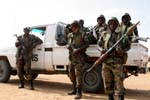
In countries like Sudan, peace agreements have been notoriously difficult to implement, weapons are relatively easy to come by, and a large portion of the population has been displaced from their homes. These are some of the most recognizable symptoms of a country experiencing conflict. But, as an updated version of the Global Peace Index, a tool for measuring peace indicators 140 countries, emphasizes, a wide range of internal and external factors influence a country’s propensity for peace.
Given the nature of our work at Enough, it comes as no surprise that all of our focus countries register in the red zone of the GPI’s ranking. Sudan and Somalia came in at the bottom of the list, with only Iraq experiencing a lower level of peace. As an interesting feature, the GPI’s accompanying report highlights in more detail the specific characteristics of the 10 most peaceful and the 10 least peaceful countries in the world, which include:
Most At Peace: (1) Iceland, (2) Denmark, (3) Norway, (4) New Zealand, (5) Japan, (6) Ireland, (7) Portugal, (8) Finland, (9) Luxembourg, (10) Austria
Least At Peace: (130) Colombia, (131) Russia, (132) Lebanon, (133) North Korea, (134) Central African Republic, (135) Chad, (136) Israel, (137) Afghanistan, (138) Sudan, (139) Somalia, (140) Iraq
Produced by the Institute for Economics and Peace, a new global think tank that researches the relationship between economics, business and peace, the researchers sought to take a first step toward systematically identifying and measuring the cultural attributes and institutions characteristic of peaceful states. As the authors note, defining ‘peace’ is a challenging task that can be hampered by a variety of biases, but by seeking input from an international panel of academics, business people, philanthropists and peace institutions, the GPI emerges as a useful tool for conceptualizing the factors that promote peace.
Click here to learn more about the index and its role in building enduring peace in conflict areas.
Photo: African Union peacekeepers in Sudan