
No Lesser Evil?

 
Congo disarming

Goma, North Kivu province, DR Congo—Last week, on February 25, a large and self-congratulatory ceremony was held in the provincial capital of Goma to mark the end of the Congo-Rwanda joint military operation against the Forces démocratic pour la libération du Rwanda, or FDLR, the Rwandan Hutu rebel group led by former génocidaires, and the departure of the Rwandan Defense Forces, or RDF, at least 4,000 of whom had entered eastern Congo about a month earlier. The joint offensive was hailed as a success and as a powerful symbol of a new spirit of collaboration between the countries of Congo and Rwanda. The Congolese Minister of Defense, Charles Mwando Nsimba, even went so far as to say that the FDLR threat had been “neutralized.” International journalists have also emphasized the operation’s successes. Both the Economist and the New York Times published stories last week highlighting hopeful changes in the region.

But was the operation a success? Has the threat been neutralized? Most analysts on the ground—and indeed many Congolese people whom I have asked—would say not. John Numbi, Congo’s Police Inspector General who commanded the joint operation, reported during the last week’s ceremony that coalition forces had captured 27 FDLR troops and had killed 153. Largely as a result of the operation, there was also a sharp increase in the number of ex-FDLR combatants and their dependents that were repatriated to Rwanda. But what about the remaining FDLR combatants, which were estimated before the operation to number over 6,000 rebels? They were forced to flee deeper into the bush, where they remain the dangerous X factor.

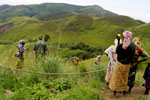
In the town of Masisi in eastern Congo’s North Kivu province, Congolese army (also known by its acronym, FARDC) soldiers walk languidly along the dirt roads. The government forces in this area are now “FARDC mixte,” a mixed Congolese army brigade created from a so-called “fast-track” integration process. This integration combined forces once loyal to Laurent Nkunda and his Congrès national pour le défense du peuple, or CNDP, and other militia groups with Congo’s army to combat their common enemy: the FDLR.

As recently as four months ago, when wide swathes of North Kivu province were controlled by Nkunda’s CNDP rebels, the hills surrounding Masisi town were controlled by CNDP soldiers who could often be seen at the top of the sharp ascending hills, patrolling the outskirts of Masisi district, an area that the United Nations peacekeeping mission in Congo, or MONUC, had declared a “no-go” zone.

With the departure of the Rwandan troops, there are no longer coalition forces to fight the remaining FDLR rebels. The newly integrated “FARDC mixte” forces are now meant to occupy the areas once controlled by the FDLR. But Bertrand, a Masisi resident, told me that he isn’t so sure that this new FARDC presence will be able to hold back the FDLR when they attempt to return to some of their strongholds in certain areas of Masisi district. “So you are sure they will come back, even in areas where FARDC mixte is now deployed?” I asked. “Yes, they always come back. And when they do, it’s horrible.” I asked if the Congo-Rwanda joint operations against the FDLR had been a bad idea because of the threat of FDLR retaliatory attacks now posed against civilians. He shrugged his shoulders and slightly tilted his head in the direction of a “FARDC mixte” soldier. “It’s difficult to say. Before, we were surrounded by the CNDP. And they were bad too.” 

For the war-weary Congolese people of North Kivu province like Bertrand, the shifted—and still shifting—alliances of eastern Congo’s rebel groups may be a cause for more fear and more insecurity. But recent developments—including the return of ex-FDLR combatants and their families to Rwanda and the return of displaced Congolese to their home villages in formerly CNDP-occupied zones like Masisi—may be early signal of more peaceful winds to come—with a very large caveat. Tremendous work still remains to be done if the rhetoric of success is to become a lasting reality.

Selon une estimation de 2007, le revenu médian par ménage de la ville était 82669 $, ce qui est typique d'une banlieue de classe moyenne supérieure et à proximité du revenu médian des ménages de San Jose, en Californie. Ceci est dû à une proportion exceptionnellement importante de locataires dans la ville. Il ya tant de locataires à Beverly Hills que les propriétaires ne sont pas la majorité. Des locataires des logements occupés constituent 56,6 pour cent du parc immobilier de la ville et le revenu médian des ménages locataires de logements occupés dans la ville est 48179 $, ce qui est légèrement supérieur à la moyenne pour l'ensemble des États-Unis.

Le revenu médian par famille est 110040 $. Les hommes avaient un revenu médian de 72004 $ contre 46217 $ pour les femmes. Le revenu par habitant de la ville était 65507 $. 9,1% de la population vit en dessous du seuil de pauvreté, la plupart d'entre eux étaient âgés de 65 ans et les seniors.
Fullerton Ca Foreclosures | Home For Sale 3.5% FHA Home For Sale | Fontana Ca Foreclosures 100% VA Beverly Hills Ca Foreclosures | Anaheim Ca Foreclosures Zero Down USDA Lancaster Ca Foreclosures | Irvine Ca Foreclosures Half Percent Down Glendale Ca Foreclosures | Burbank Ca Foreclosures 203 K FHA Fremont Ca Foreclosures | Moreno Valley Ca Foreclosures Conventional Loans Los Angeles Ca Foreclosures | Torrance Ca Foreclosures Jumbo Loans Santa Ana Ca Foreclosures | San Clemente Ca Foreclosures City Down Payment Pasadena Ca Foreclosures | Newport Beach Ca Foreclosures 2yr BK Discharge OK Long Beach Ca Foreclosures | Mortgage Calculator <620 FICO with No 12 mo lates Mortgage Calculator | Berkeley Ca Foreclosures 620+ FICO Ok Hemet Ca Foreclosures | Huntington beach Ca Foreclosures 6% Seller Credit OK Lake Elsinore Ca Foreclosures | Murrieta Ca Foreclosures 30 Yr Fixed Palm Springs Ca Foreclosures | Palmdale Ca Foreclosures 15 Yr Fixed Victorville Ca Foreclosures | Whittier Ca Foreclosures 20 Yr Fixed LOS ANGELES Ca Foreclosures | SAN JOSE Ca Foreclosures 5 Yr Adjustable SACRAMENTO Ca Foreclosures | CORONA Ca Foreclosures 7 Yr Adjustable LONG BEACH Ca Foreclosures | OAKLAND Ca Foreclosures 10 Yr Adjustable

I hope that peace will finally prevail here... because as said that as recently as four months ago, when wide swathes of North Kivu province were controlled by Nkunda’s CNDP rebels, the hills surrounding Masisi town were controlled by CNDP soldiers who could often be seen at the top of the sharp ascending hills, patrolling the outskirts of Masisi district, an area that the United Nations peacekeeping mission in Congo, or MONUC, had declared a “no-go” zone. It was alarming situation especially for the residents. Times like this should really be terminated and let peace prevail my friends!

Long Beach Ca Homes For Sale | Ca Homes For Sale | Ca Homes For Sale | Berkeley Ca Homes For Sale | Hemet Ca Homes For Sale | Huntington beach Ca Homes For Sale | Lake Elsinore Ca Homes For Sale | Murrieta Ca Homes For Sale | Palm Springs Ca Homes For Sale | Palmdale Ca Homes For Sale | Victorville Ca Homes For Sale | Whittier Ca Homes For Sale | LOS ANGELES Ca Homes For Sale | SAN JOSE Ca Homes For Sale | SACRAMENTO Ca Homes For Sale | CORONA Ca Homes For Sale | LONG BEACH Ca Homes For Sale | OAKLAND Ca Homes For Sale | Long Beach Ca Foreclosures | Ca Foreclosures | Ca Foreclosures | Berkeley Ca Foreclosures | Hemet Ca Foreclosures | Huntington beach Ca Foreclosures | Lake Elsinore Ca Foreclosures | Murrieta Ca Foreclosures | Palm Springs Ca Foreclosures | Palmdale Ca Foreclosures | Victorville Ca Foreclosures | Whittier Ca Foreclosures | LOS ANGELES Ca Foreclosures | SAN JOSE Ca Foreclosures | SACRAMENTO Ca Foreclosures | CORONA Ca Foreclosures | LONG BEACH Ca Foreclosures | OAKLAND Ca Foreclosures |

I hope that peace will finally prevail here... because as said that as recently as four months ago, when wide swathes of North Kivu province were controlled by Nkunda’s CNDP rebels, the hills surrounding Masisi town were controlled by CNDP soldiers who could often be seen at the top of the sharp ascending hills, patrolling the outskirts of Masisi district, an area that the United Nations peacekeeping mission in Congo, or MONUC, had declared a “no-go” zone. It was alarming situation especially for the residents. Times like this should really be terminated and let peace prevail my friends!

Long Beach Ca Homes For Sale | Ca Homes For Sale | Ca Homes For Sale | Berkeley Ca Homes For Sale | Hemet Ca Homes For Sale | Huntington beach Ca Homes For Sale | Lake Elsinore Ca Homes For Sale | Murrieta Ca Homes For Sale | Palm Springs Ca Homes For Sale | Palmdale Ca Homes For Sale | Victorville Ca Homes For Sale | Whittier Ca Homes For Sale | LOS ANGELES Ca Homes For Sale | SAN JOSE Ca Homes For Sale | SACRAMENTO Ca Homes For Sale | CORONA Ca Homes For Sale | LONG BEACH Ca Homes For Sale | OAKLAND Ca Homes For Sale | Long Beach Ca Foreclosures | Ca Foreclosures | Ca Foreclosures | Berkeley Ca Foreclosures | Hemet Ca Foreclosures | Huntington beach Ca Foreclosures | Lake Elsinore Ca Foreclosures | Murrieta Ca Foreclosures | Palm Springs Ca Foreclosures | Palmdale Ca Foreclosures | Victorville Ca Foreclosures | Whittier Ca Foreclosures | LOS ANGELES Ca Foreclosures | SAN JOSE Ca Foreclosures | SACRAMENTO Ca Foreclosures | CORONA Ca Foreclosures | LONG BEACH Ca Foreclosures | OAKLAND Ca Foreclosures |

While your report is marginally well written, I have problems with three issues.

First, your second to last paragraph includes your conversation with "Bertrand" - an anonymous Congolese citizen. You quote Bertrand as if his views represent the majority of the Congolese populace. This anecdotal evidence, while interesting on a very superficial level, does not provide any hard evidence as to the effectiveness of the joint Congolese-Rwandan operation.

Secondly, your report doesn't provide anything new. You say on the one hand that the operation may not have been the success the respective governments claim it was, and on the other hand maybe it will bring some lasting change. Congratulations. You are correct.

Lastly, one has to wonder about the integrity of the reporting and your conclusion that "tremendous work still remains..." Is it possible that your reporting is influenced by the fact that continuation of the conflict ensures your job security?