

There are 132 days left until two decisive votes take place in Sudan. That deadline, and the increasing unlikelihood that it will be met, prompted the Obama administration to send an expanded negotiating team under the leadership of former ambassador Princeton Lyman to Sudan last week. These extra “diplomatic boots on the ground,” as the State Department called them, and the display of high-level engagement that they represented, are a necessary and welcome step. But, without a clearly spelled-out Sudan policy from the top, one that defines which incentives and pressures the administration is willing to deal out and what actions or inactions will trigger those responses, the expanded U.S. ground presence will not have the necessary direction to do its job effectively.
In the eleven months since the unveiling of its Sudan policy last October, the Obama administration has appeared more consumed by infighting than the implementation of its approach. Over the weekend, New York Times columnist Nick Kristof outlined the failings of President Obama’s approach to Sudan thus far and, more importantly, the potential human cost of continuing to fail. He wrote:
“(…) Mr. Obama is presiding over an incoherent, contradictory and apparently failing Sudan policy. There is a growing risk that Sudan will be the site of the world’s bloodiest war in 2011, and perhaps a new round of genocide as well. This isn’t America’s fault, but neither are we using all of our leverage to avert it. (…) [T]he problem isn’t that the administration is too busy to devise a policy toward Sudan but that it has a half-dozen policies, mostly at cross-purposes.”
According to sources, including the Washington Post’s article on the administration’s intensified efforts in Sudan, the president and his advisers are currently reviewing U.S. policy toward the country, and are notably “mulling over incentives” to secure the Sudanese government’s cooperation. Incentives are of course necessary, but so are pressures, not in the least because there should be some consequences for the role that the government has played in the recent deterioration of the situation in Darfur. As Kristof points out, Khartoum “sees that it pays no price for misbehavior,” and this only encourages it to continue on a path that makes peace more elusive.
In recent weeks, the Sudanese government has stepped up restrictions on humanitarian aid organizations, quietly expelling a handful of workers in the last month and blocking humanitarian access to a camp for displaced Darfuris in the south. The government has also proposed “domesticating” the Darfur issue, a strategy that may sound good in theory, but that many believe is an attempt to extricate the international community from the peace process altogether, and may ultimately solve the Darfur “problem” through massive violations of the rights of the displaced. Alarmingly, reports indicate that the U.S. has signed off on the dubious plan. Preparations for the two referenda are not going well either; the Abyei vote seems indefinitely stalled as tensions on the ground mount, while substantive preparations for the southern referendum only recently started. Yet while the administration has intensified its efforts on the referendum, it has stayed largely silent on Darfur.
In the little time left until the two referenda, it seems that the administration has decided to prioritize a smooth southern referendum over other issues and principles, including some of those outlined in its original policy. In doing so, the administration has opened itself up to manipulation by Khartoum and a government that can dangle the prospect of a failed or insecure referendum before U.S. diplomats, while stalling or fueling other issues however it sees fit. Bashir’s brazen visit to Kenya last week, which solicited only ‘disappointment’ from President Obama, shows just how far he can push the envelope. The right decision for the president to make at this juncture is to return to the administration’s October policy, one composed of both incentives and pressures and one that looks at the conflicts in Sudan comprehensively.
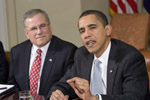
Photo: President Barack Obama and U.S. Special Envoy to Sudan Major General Scott Gration (AP)