

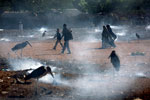
If the Obama administration is looking for examples of how not to fight terrorism and help rebuild failed states, it should take close look at the Bush administration’s disastrous policies in Somalia. It was so driven by short-term counter-terrorism objectives and targeted military strikes against alleged al-Qaeda targets inside Somalia that some within the U.S. intelligence community jokingly refer to Bush-era policy as ‘whac-a-mole.’
With a change in administration and a number of new developments inside Somalia—most significantly the withdrawal of Ethiopian forces and the election of a moderate Islamist as president—now is the time for the United States to re-evaluate its approach. Enough released a new report on Somalia today by Ken Menkhaus, an associate professor of political science at Davidson College and one of the world’s pre-eminent analysts of the Horn of Africa. The report makes two principal arguments that we hope the Obama administration absorbs as it considers how best to engage in one of the world’s most vexing crises.
First, Ken argues that the Obama administration must acknowledge that Somalis themselves must manage and resolve the political crisis, and that the appropriate role for the United States, the United Nations, and other external actors is to help create the conditions in which this can occur. More aggressive approaches—from the international military intervention in the early 1990s to the Bush administration’s enthusiastic support for an abusive transitional government—have not produced the desired results. “U.S. policymakers,” Ken writes, “must approach Somalia with humility.”
Second, Ken argues that the fight against terrorism and Islamic extremism is best served through conditioned support for a broad-based coalition government under the leadership of newly elected President Sheikh Sharif Ahmed, a moderate Islamist. The ‘whac-a-mole’ approach has only fed into rising anti-Americanism and violent extremism. As I noted last year, it is time for the United States to put down the mallet and pick up the phone to help Somalis themselves drain support for the extremist militia known as the shabaab. My colleague John Prendergast said it best a recent interview with CNN:
"You don’t immediately confront a group like this—they [shabaab] are at their high point. You fight it politically and draw support slowly and patiently … for clans and organizations in Somalia that don’t really want them there.”