

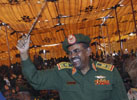
There was more controversy over Sudan President Omar al-Bashir’s inauguration this weekend, with the U.N. announcing that its top two Sudan officials would attend the swearing-in ceremony of the only sitting head of state targeted by an International Criminal Court arrest warrant.
The two officials, Haile Menkerios and Ibrahim Gambari, head the two U.N. peacekeeping missions in Sudan, UNMIS (the mission in Sudan) and UNAMID (the hybrid mission with the African Union in Darfur), respectively. The U.N.’s decision came on the heels of Human Rights Watch letters last Friday calling on Secretary of State Hillary Clinton, E.U. foreign ministers, and ICC member states to not send representation to Bashir’s inauguration. In the letters, HRW cites U.N. legal guidelines regarding contact with indicted individuals:
“[T]he presence of UN representatives in any ceremonial or similar occasion with [persons indicted by international criminal courts] should be avoided.”
Awkwardly, it seems that the United Nations has gone against its own better judgment. A U.N. spokesperson justified the decision, saying that the two officials “interact with the host government regularly on operational issues to ensure that their missions are able to function effectively and to address areas of mutual concern.” Another U.N. official told Reuters that the act is one of “diplomatic courtesy.”
The U.N.’s attendance of Bashir’s inauguration carries such symbolic import that it goes beyond simple courtesy. It is also strategically flawed. Will the U.N.’s attendance of Bashir’s inauguration really convince Khartoum to allow peacekeeping troops in Darfur to freely investigate the civilian atrocities that continue to be perpetrated by the regime itself? What kind of message does U.N.’s presence at this celebratory event send to the Bashir regime – and to Sudanese across the country who have suffered under the regime for the past 21 years – about the legitimacy of his presidency following what was widely denounced as a deeply flawed election?
Photo: Sudanese President Omar al-Bashir visits supporters in Khartoum after being confirmed as the winner of Sudan’s April elections. (AP)