

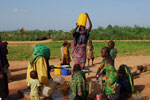
It’s clear that the humanitarian crisis in Darfur has reached a desperate point when the U.S. Embassy in Khartoum issues statements like the one it put out today:
The United States is deeply concerned by the growing humanitarian crisis in Zam Zam IDP (Internally Displaced Person) Camp in North Darfur. The arrival of over 36,000 IDPs fleeing recent fighting in South Darfur between rebels and the government has severely strained camp resources. This ongoing crisis is exacerbated by the March 4 expulsion of 13 major international non-governmental organizations (INGOs) and the dissolution of three Sudanese NGOs by the Sudanese Government. While the GOS, United Nations (UN), and remaining NGOs have been exploring ways to fill the gap created by this emergency, there is a growing water shortage due to the demand created by recent IDP arrivals and the lack of available water resources at the camp. In addition, the influx of new IDPs has created a need for more land to accommodate the overflow. We urge the Sudanese Government, in close cooperation with the UN and the NGOs, to move quickly to address water, land, and other urgent issues at Zam Zam Camp and other IDP camps across Darfur before the humanitarian situation deteriorates any further.
Following the expulsion of the aid agencies, Khartoum adamantly claimed that the government of Sudan would fill the gaps in services left in the wake of the NGOs’ departure. The U.N.’s top humanitarian official John Holmes quickly countered Khartoum, expressing the urgent concern of many in the aid community: "We do not, as the U.N. system, the NGOs do not… and the (Sudanese) government does not have the capacity to replace all the activities that have been going on, certainly not on any short- or medium-term basis," he said.
Last week, aid workers in Sudan said they feared the Darfur camps would reach a crisis point in as little as two weeks. "First the water supplies will go, without the technicians to repair [them]; then there will be problems with food supplies, then healthcare,” one aid worker said. The U.S. Embassy’s statement today suggests that the nightmare predicted is becoming reality.