
Blog Series
Categories
Our Campaigns & Initiatives
Announcements
Archive
- May, 2012 (36)
- April, 2012 (62)
- March, 2012 (64)
- February, 2012 (53)
- January, 2012 (53)
Blog Roll
- Africa in Transition
- Africa24 Media
- Across the Aisle
- Burning Billboard
- Change.org - Human Rights
- Chris Blattman's Blog
- Condition Critical
- Congo Siasa
- From the Front Line
- Genocide Intervention Network
- Huffington Post
- ICC Observers
- IJCentral
- Impunity Watch
- In Situ
- Institute for War & Peace Reporting
- Opinio Juris
- Meskel Square
- Mia Farrow
- National Security Network Democracy Arsenal
- Nicholas Kristof, The New York Times
- Promise of Engagement
- Pulitzer Center - Untold Stories
- Resolve Uganda
- Save Darfur
- South Sudan Info
- STAND
- SudanReeves.org
- TakePart
- Think Progress
- UN Dispatch
- Voices from the Field
- Voices on Genocide Prevention
- War Crimes
- WITNESS
- Woodrow Wilson Center
- World is Witness
- Wronging Rights
While World Watches Washington, Rwandan Troops Enter Congo
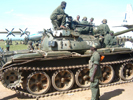
You might have been paying attention to other things on January 20, but major developments unfolded in the Great Lakes region of Africa that morning as 3,000 Rwandan troops crossed into North Kivu, Congo, as part of a joint operation with the Congolese army to take on the FDLR, the Rwandan-affiliated Hutu militia. Although Enough has been pressing for international action to remove the FDLR from eastern Congo for quite a while, several aspects of this operation make us uneasy:
- Bosco “The Terminator” Ntaganda, indicted by the International Criminal Court, and his dissident rebel faction are collaborating with the Rwandan and Congolese armed forces in a move against the FDLR. Involving a suspected war criminal in an international military operation is a really bad idea.
- Although Congolese President Joseph Kabila appears to have invited the Rwandans into the Kivus, ordinary Congolese people have a fairly strong antipathy to foreign armed forces, particularly since Rwanda’s four-year occupation of eastern Congo from 1998 to 2002.
But most worrisome in terms of civilian protection, the United Nations doesn’t seem to be involved whatsoever in planning this operation, despite recent augmentations to the mandate of MONUC, the peacekeeping force for Congo. Worse, recent reports have the Congolese army blocking access by UN peacekeepers and aid workers to areas north of Goma.
Stay tuned for much more on this from the Enough Project as it unfolds.


When Obama inauguration was going on, I sat down and wrote my thoughts about events in the Great Lakes Region of Africa. Unfortunately, I didn't anticipate things to go so fast. Dear friends, when I read many articles about that region, i get disappointed, because many people believe they get what is going on there. I would advise to open your eyes and educate yourselves. For Minnesotans, we are glad to have an Expert on that region, here in St Paul,Professor Peter Erlinder. Please talk to him for now, and just follow closely in months to come the events at that region. My guess is the capture of Nkunda is a "mounted or created news". We will see!
Here were my thoughts two weeks ago, and I think I am still right on the events:
This is to warn international community and all Great Lakes citizens that fake ceasefires, montage of agreements, and all misleading negotiations are taking effect through the whole region. Please don’t get misguided; the same events that preceded Rwanda Genocide in 1994 are taking place.
From Eastern DRC to all DRC
First, we believe that the announcement of a bilateral ceasefire by senior officers of the main Tutsi rebel group in the east of the Democratic Republic of Congo with government forces is characterized by unclear politics. Please don’t get trapped in the idea that the breakaway faction of the National Congress for the Defense of the People (CNDP) of Bosco Ntaganda said that its fighters would join the Congolese army. It is for us obvious that this is a strategic decision to show the public that negotiated peaceful solutions are undergoing, meanwhile war continues towards the western provinces, why not to Kinshasa if possible. If all the groups concerned really had good intentions, they would hand some of their elements, who are war criminals to the International Court. These include Laurent Nkunda and Bosco Ntaganda. There can’t be a lasting peace without justice for all.
Contradictory and Dynamic War
Second, if DRC and Rwanda negotiated with CNDP, why not negotiate with the FDLR as well? It is hard to see how stopping violence on one side and increase attacks on the other side will lead to real peace.
In fact in near future, in agreement with Congo, Rwanda will, again, bring its army in Congo to “disarm” the FDLR. Why would Congo agree to have Rwandan army on its territory? What is the role of Monuc in this situation? Why not let European Union send some peace keepers as suggested. Does anyone think that this is best strategy to bring back peace in the Great Lakes region? It looks like RDC army, CNDP and Rwandan army plan to use the force to disarm the FDLR, which might expend the war on even a bigger region. Meanwhile poor DRC citizens will continue to suffer and die.
As some of you remember, in 1993, RPF, Kagame’s movement, was allowed by Arusha Peace Accord to bring 600 men in Kigali for the security of their people. It is now known that they ended up by having more than 2000 people in stead plus arms. In 1996 Kagame’s army invaded refugees’ camps in Eastern Congo, pretending it was just to bring refugees back and to “chase Interahamwe”. The war continued for months, till Kinshasa where Kabila father seized the power. This is a pattern in Kagame’s behaviors. Letting Rwandan Army go to Congo again is continuing and intensifying the violence and the misery of residents in that region. Thousands of refugees and Congolese citizens were killed. We know what happened next. They continued the war till Kinshasa, helped Kabila father to take the power.
A masked goodwill
Third, let us accept that Rwanda, DRC, MONUC and EU want bring peace in the Great Lakes. We understand that the actual government of Rwanda has denied any involvement with CNDP of Laurent Nkunda. We are wondering the reason behind this sudden change of leadership from Laurent Nkunda to Bosco Ntaganda, both International Justice wanted men! Why all of a sudden Rwanda was involved in Cease fire negotiation? We believe that the strongman of Kigali (Paul Kagame) is mounting, a divide and conquer, or fake unity and conquer. These two strategies worked for him during the negotiation of Arusha Peace Accord between RPF (Rwandese Patriotic Front) and Rwandan government in 1993 at Arusha, Tanzania. They were negotiating pseudo peace while marching to Kigali, the capital of Rwanda. We have no doubt that Ntaganda or Nkunda, whoever is the head of CNDP, which doesn’t matter to the citizens of Great Lakes region, something big is developing, and International Community and Great Lakes citizen should start widely opening their eyes and act quickly.
In the aftermath of the Rwandan genocide, the Tutsi-dominated RPF held an unbroken spell of power up to date.
With the capture of Kigali by RPF, on July 4, 1994, the simultaneous killings of both Tutsis and Hutus finally came to a temporary halt.
It is widely known that after Kigali’s capture by the RPF, the rebels continued killing Hutu civilians and other Tutsi and Twa dissenters in what has now come to be absurdly rationalized as their “reprisal killings.”
Just as in the course of the civil war, a large numbers of Hutu civilians were deliberately massacred by RPF troops – a fact substantiated in the so-called Gersony report named after the UN official who investigated the killings.
After the RPF took over power, an even greater number of Hutu lost their lives within and outside Rwanda at their hands
This situation got worse with the destruction of Rwandan refugee camps and the hunt down of Rwandan refugees through out the Ituri forest.
Since for nearly two decades one sided justice has been rendered, it is time to call upon all good citizens to work together and the culture of impunity widespread in the region. This means that all culprits must be arrested and prosecuted for war crimes and/or crimes against humanity.
Stating that the root causes of the current DRC crisis steem from the presence of the FDLR in estern Congo is a terrible mistake.
It simply denotes ignorance of the reality on the ground and poorly hides the obvious intention of some western powers to give Rwandan businesses continued access to Congolese minerals and forests, an approach that was recently ill-conceived and ill-advised by Mr. Herman Cohen.
For the sake of equity, national reconciliation, justice for all, halt to the culture of impunity, and bring about lasting peace in the Great Lakes region of Africa, the Enough activists should urge the Obama administration to seize this opportunity to create an internationally administered Truth and Reconciliation Commission for Rwanda, modeled to the one that took place in South Africa.
The ongoing joint military operation against the FDLR in eastern Congo is likely to worsen the crisis just as this recently was the case with regard to the military operation against the LRA rebel group by the armies of Uganda, Congo, and Southern Sudan in mid-December 2008.
As this week marks a very monumental move for the area - Rwanda deploying 3,500 troops into Congo, the arrest of Nkunda, we are reminded that now the real work is beginning. I am concerned this operation will only mean more bloodshed and further violence for the people in the Great Lakes region of Africa.
About the root cause of the crisis in eastern Congo:
The presence in the DRC of what the media calls "Hutu genocidaires" is a direct consequence of the military coup which put the RPF on power in Rwanda. Up to date, the RPF continues to spread lies that its decision to take power by force in Rwanda was directly linked to its willingness and determination to end the Rwandan genocide in 1994.
This baseless argument does not stick at all since every Rwandan knows that the Rwandan genocide of 1994 was not the cause of the Rwandan civil war which began in 1990. Instead, the Rwandan genocide of 1994 was a direct consequence of the Rwandan civil war which spanned from 1990 to 1994.
In addition, the Rwandan genocide was triggered by the terrorist attack against the Rwandan presidential aircraft on April 6th, 1994. Numerous reliable sources attest that this terrorist attack is the triggering event of Rwandan genocide and that it was ordered and executed by the RPF.
In 1994, the RPF was indeed in a desperate need of a strong argument so that it can resume the Rwandan civil war which had been ended by the Arusha Peace Agreement signed between the RPF and the Rwandan government on August 4th, 1993.
The RPF wanted to resume the war because the application of the Arusha Peace Agreement would have lead in just 22 months to democratic elections and the RPF was strongly convinced that there was no way it could have won these elections.
The RPF was in great fear of a strong coalition that would have emerged between MRND, MDR, and PSD political parties before and/ or after these elections. This great fear was somehow real: in neighboring Burundi, the political party of Pierre Buyoya (UPRONA) had just lost the democratic elections.
On one hand, the RPF back-up base in Burundi, the second largest back-up base both politically and militarily, was in great danger of being wiped out. On the other hand, well-informed sources suggested that in Rwanda, MRND, MDR, and PSD political parties were gaining key allies in neighboring Burundi. That is why the RPF decided to halt the implementation of the Arusha Peace Agreement by resuming hostilities in Rwanda.
On April 6th, 1994 the RPF fired two missiles, shot down the Falcon 50, and killed at scene two African Heads of State: the Rwandan president Juvenal Habyarimana and the Burundian president Cyprien Ntaryamira.
This terrorist act achieved two goals. Firstly, by killing the Burundian President Cyprien Ntaryamira, the RPF halted, at least temporarily, the democratic process in Burundi and stabilized its back-up base in this country. Secondly, by killing the Rwandan president Juvenal Habyarimana, the RPF triggered the resumption of the Rwandan civil war and at the same time halted the implementation process of the Arusha Peace Agreement.
In the aftermath of signing the Arusha Peace Agreement, the RPF deliberately resumed the recruitment of new combatants long before the April 6th 1994 terrorist act. In strong violation of the Arusha Peace Agreement, these new RPF recruits were enlisted in the APR late in March 1994.
The consequences of this enlistment are well-known: crimes of genocide, collapse of the Rwandan government, exodus of 2.5 million Rwandans to Tanzania, then to Burundi, and finally to the DRC, which alone received more than 1.5 million Rwandan refugees in its two eastern provinces of North Kivu and South Kivu, provinces that are up to date war torn. Moreover, from 1996 to 1997, the RPF continued to track the ex-FAR inside the DRC in order to exterminate them and install its allies in Kinshasa.
To achieve this goal, the RPF massacred at least 200,000 Rwandan refugees inside the DRC. It even tried to conceal evidence for these mass killings by burning victim corpses and scattering the ashes away in the forest and/ or in the river. Such a sinister plan was thwarted when a revolutionary Congolese, the late Laurent-Desire Kabila, took power in the DRC and decided to restore the sovereignty of the land.
In August 1998, the RPF launched a new war aiming at not only completing the installation of its allies in Kinshasa, but also to prevent any international criminal justice inquiry into its role in the DRC, given the extent of war crimes and crimes against humanity committed by its army. Some of these crimes have already been documented by an investigation team established by the UN Secretary-General. This new proxy war in the DRC made it possible for many survivors of the Rwandan refugee massacres of 1996 and 1997 to stand up and defend themselves against this strenuous common enemy.
The birth of the FDLR is a direct consequence of the RPF sinister plan in the DRC. That is the origin of the current proxy war in the province of North Kivu. In other words, the origin of the current DRC civil war is in Kigali not in Goma or in Kinshasa. Sooner or later this problem will be solved.
This crisis is the result of the RPF refusal to face free democratic elections in Rwanda. It also is the result of the RPF inability to handle the actual state of Hutu-Tutsi problems in Rwanda. Indeed, the RPF regime has been trying to underestimate and ignore the existence of such Hutu-Tutsi problems in Rwanda.
In Rwanda, there are nearly 85% Hutus and 14% Tutsis. Democratic elections in Rwanda would probably give back the power to a "Hutu" movement.This analysis has always been in the RPF calculations with regard to plausible results of democratic elections in Rwanda. The RPF suggests that such results simply denote "confusion between the ethnic majority and the political majority."
Since 1993, the RPF estimates that such results would inexorably relegate it to the opposition for an indefinite period of time. Indeed, this is the case for the UPRONA of Pierre Buyoya in neighboring Burundi since the democratic elections of June 1993 and 2005.
This also is the case in South Africa where democratic elections have thrown the National Party of De Klerk (now renamed the Democratic Alliance) in the opposition since 1994. That is root cause of the current DRC crisis in the province of North Kivu.
About a comprehensive solution to the crisis in Congo:
A democratic government is urgently needed in Kigali. In my opinion, it is obvious that a democratically elected government in Kigali would not need to sponsor armed groups in the provinces of North and South Kivu.
In addition, such a democratically elected government in Kigali would refuse to offer back-up bases to any Congolese armed groups, including the one belonging to the Tutsi rebel Laurent Nkundabatware, whose rebellions would shortly die off by themselves. Concerning the Rwandan armed groups, including the FDLR combatants, a democratically elected government in Kigali would not be afraid to directly discuss with them.
Direct talks between these combatants and the democratically elected Rwandan government would set up new relationships under which the armed struggle would be meaningless. These armed groups would not have any reason to refuse to face justice in Rwanda, should some of their combatants have to respond for their acts, just as any other Rwandan in similar situation would have to, especially the RPF members who are accused of several crimes, including crimes against humanity.
A democratically elected government in Kigali would provide impartial justice for all Rwandans without any discrimination. Therefore, there would be no need for such a democratic government in Kigali to request that these combatants be sent "elsewhere".
Their home is in Rwanda. That is where they belong and no where else. Most importantly, it is up to the Rwandan people to judge their fellow citizens, and not to anyone else. With numerous uncertainties and political machinations mostly owing to regional and international geopolitics, the international community can only offset the inability of the RPF regime to create suitable conditions for a fair and impartial trial in its own courts.
A realistic approach:
Anyone who is still skeptical towards such an approach should take a closer look at what the CNDD-FDD accomplished in neighboring Burundi. One should also recall that Burundi represents a good specific example because both Rwanda and Burundi share the same ethnic composition of their populations not to mention a similar dark history of sporadic ethnic cleansings.
The CNDD-FDD painfully but straight forwardly negotiated with the rebellion movement PALIPEHUTU-FNL. Interestingly, beyond all expectations, a peace deal is about to be concluded, simply because the CNDD-FDD is not longer afraid to face the PALIPEHUTU-FNL in democratic elections.
Let’s make it clear: the Hutu factor does not and will not absolutely play any role between the CNDD-FDD and Palipehutu FNL Burundian supporters. These political parties have the obligation to play modern politics. Their respective leaders, including the FRODEBU leadership, will have to propose to the Burundian Hutu voters something smarter than the length of their noses during the upcoming electoral campaigns. That is the right solution to their current political deadlock. Everything else is none other than a patch on a wooden leg.
The DRC crisis cannot be solved without taking into account its root causes that are in Rwanda. Westerners should always be aware of some misleading statements that usually characterize the RPF rhetoric.
With regard to the current political deadlock in Rwanda, it is important to recall that for several centuries to come, there will be a majority Hutu and minority Tutsi as it has always been in the Rwandan history. The RPF will not have any other voters than the Rwandan people.
It is therefore, up to the RPF to change its ideology and practices, a metamorphosis that will require that the RPF become less Tutsi but more Rwandan. That is the only way which could allow the RPF to face with confidence democratic elections that are regularly held in civilized countries.
Concerning the ethnic composition of the Rwandan population and the political mind set of the Rwandan voters, these two parameters are not prone to any change in the near future. The Republic of Rwanda will always be inhabited by a majority Hutu and minority Tutsi. Given such a situation, the RPF cannot indefinitely run away from the democratic elections. It must have the courage to face them right away.
Should the RPF lose these elections, it will have to learn from its mistakes of the past. It is now time for the RPF to get ready for the upcoming political defeat, rather than attempting, without any perspective of political reforms in the near future, to delay these democratic elections. Sooner or later democratic elections will be held in Rwanda.
That is the way the Rwandan history course has been drawn and nobody can change it. People who are still skeptical about such a realistic approach should take a closer look at South Africa where the white racist regime has done everything it could in the past to delay democratic elections by denying the voting rights to the black people. The white racist regime already knew that black people (the majority) would likely vote for a political movement mainly composed of black people.
Fortunately, there was not much the white racist regime could do about this ethnic composition of the South African population and this situation will undoubtedly last several centuries to come.
What would then the white racist regime have done to keep its head above water? Continue to be stubborn by fear of losing democratic elections? Continue to spread proxy wars in neighboring countries, under the umbrella of waging the war against the communism system, and establish a huge protective shield, spanning from Namibia to Mozambique not to mention Zimbabwe and Angola?For how long the white racist regime would have blocked the actual course of the South African history?
That is what Frederick De Klerk thoroughly understood and I strongly believe that this is probably why he won the Nobel Peace Prize that he shared with Nelson Mandela. That is also why the ANC needs a comprehensive plan that would improve the quality of life for all South African black voters besides the credit it already enjoys for having successfully fought against the apartheid.
The stake could not be higher for the ANC. It must address the social concerns of all South African people, create jobs, provide lands, decent housing, affordable healthcare system and access to higher education, etc. rather than selling out the fact of being a “black” movement.
Interestingly, that is exactly what Pierre Buyoya of Burundi has come to realize lately. Actually, there is no doubt that Pierre Buyoya deserves strong respect from the Burundian people, despite his many terrible mistakes of the past and strong disagreement from his own party leadership.
In Rwanda, one can still delay the opportunity to alleviate the sufferings imposed to the Rwandan people. However, one should keep in mind that such an attitude does not mean that the Rwandan history will not ultimately relegate the RPF into the opposition for an indefinite period of time.
Therefore, it is time for the RPF to lift its many blockades to such a great opportunity in the Rwandan history. That is how the eastern DRC might regain its lasting stability. The time for proxy wars in DRC is over. It is time for the RPF to cope with its weaknesses and humbly accept the change the Rwandan people have been waiting for.
It is time for the Rwandan people to stand up and request for an end to the current political deadlock in Kigali. Unless the RPF accept to play modern politics, it will not escape from this unfortunate fate. Keeping running away from this process by intensifying headlong rushes denotes a political anachronism of a failed regime.
Unfortunately, such an attitude inexorably prolongs the sufferings of the Rwandan people who are desperately begging for help. Tenacious memories still rime in so many Rwandans who survived the RPF atrocities. Therefore, the more the RPF will intensify its headlong rushes, the longer will be the time it will have to spend in the opposition.
In the 2010 Rwandan presidential elections, the RPF will have one more chance to make up its mind set for the common good of the Rwandan people.
The Rwandan troops led by the current Rwandan President Paul Kagame occupied the Congo for 10 years. They did not succeed to remove the FDLR. Instead the concentrated on murdering millions of Congolese people and Rwandan refugees (mostly babies, the elderly, and women), raping of hundreds of thousands of women, recruiting thousands of child soldiers, and looting and stealing Congo's natural resources. 6 million deaths later, as a result of several Rwandan invasions, the invader is claiming to be the peacemaker invited by the Congolese president Desire Kabila. It is evident that the Congolese people oppose this including the Banyamulenge whom Rwanda claims to protect. This fact in itself is laughable.
What's tragic is that this will lead to more killings of the civilians. The Rwandan soldiers have a history of committing mass murder in the Congo and this will happen again this time around. It is no accident that the UN forces (MONUC) have been banned fromt he areas where they are operating. It is no accident that they AID agencies have been banned from entering the operation areas. This is to hide the attrocities these forces will committ againt the Congolese people. It is no accident that Rwanda has banned a well known human right activist Allison Desforges from entering Rwanda.
At the same time, Rwanda will use this as a public relations tool to repair its image after the recent UN Security Council report that showed exactly the role of Rwanda in the Congo.
Let us not be fooled by this act as a way to end the conflict. The longer Rwanda continues to be ruled by Kagame's iron fist, represses democracy, jails and tortures opponents, there will not be a solution to the FDLR. A Dialogue to resolve this issue is a MUST and NOT WAR.