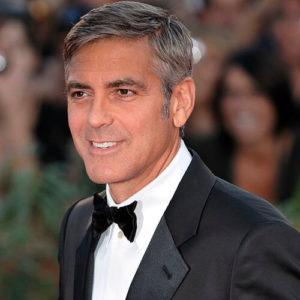
George Clooney

Printer-friendly version

Clooney and Curry Turn Spotlight on Chad

 Safety and hopeSome people question whether celebrity activism makes a difference. On Sunday, NBC’s Dateline aired “Goals for Chad: Safety and Hope,” Ann Curry’s and George Clooney’s report from eastern Chad about displaced Darfuris. Yesterday, President Obama appointed Major General J. Scott Gration as the U.S. Special Envoy for Sudan, and it’s in no small part thanks to the sustained effort of activists—like Clooney—who urged the administration to make this appointment quickly.

In the end, what matters is that strong action is taken now to end the crisis in Darfur. In this crucial moment, when millions of lives are hanging in the balance, a wide variety of sustained and coordinated—but also creative—kinds of activism are needed to deliver a clear message to our leaders. On last Sunday’s Dateline program, George Clooney succeeded (with Curry’s support) as an activist because he drove home two important messages on the crises in Darfur and eastern Chad to millions of Americans:

  • First, Clooney delivered his “policy ask,” which was for the Obama administration to appoint a high-level, full-time special envoy that reports to the President to, as Clooney said himself, “work hard, every day,” for peace in Darfur and throughout Sudan.
  • Second, he gave people here in the U.S. and around the world who were watching Dateline a reason to hope for a resolution to the conflict in Darfur, because he highlighted the incredible hope, perseverance, and courage of Darfuri refugees who refuse to give up and who continue to endure enormous hardships.
     

Everyone knows that hope is not enough. Words are not enough. Taking action and raising one’s own voice are what count. The Darfur anti-genocide movement has shown that activism matters. And today, as Enough asserted in our latest strategy paper, “the activist movement for peace in Sudan is needed now more than ever.” We all ought to follow Clooney and Curry’s lead and do our part to show the Obama administration that not only have we not lost hope, but we will not be silent. We’re waiting impatiently to see that they are doing everything in their power to fulfill their duty to help end the suffering of millions of Darfuris by devoting substantial resources to a renewed peace effort for Darfur.

WATCH a clip from the Dateline program.

Africa: Getting the Continent on the Obama Agenda - allAfrica.com

Date: 
Feb 26, 2009
Author: 
Reed Kramer

George Clooney's meeting to discuss Darfur with Vice President Joe Biden and with President Barack Obama Monday night at the White House provided one of the first glimmers of Africa involvement from the top echelon of the new administration.

According to Biden spokeswoman Elizabeth Alexander, Clooney was told that Sudan policy is under "ongoing review." The Academy Award-winning actor, who skipped the Oscar's ceremony Sunday night to fly to Washington, said he welcomed what he heard "because there was some concern this could fall off the radar."
 
Continue reading here.

Clooney Announces Darfur Envoy - Politico

Date: 
Feb 25, 2009
Author: 
Nia-Malika Henderson

Advocates for U.S. intervention in the Darfur conflict, angered by what they saw as Bush administration foot-dragging in a case of genocide, have pressed for stronger leadership from the White House for a long time.

 
So imagine their glee when leading man George Clooney, twice named People magazine’s sexiest man alive, announced this week that the administration would appoint a special envoy to tackle the issue.
 
“This is a phenomenal outcome, with the extraordinary series of crises that the new president has inherited, to have someone of Clooney’s stature and seriousness galvanize attention to this question on Darfur,” said John Prendergast, co-­chairman of the ENOUGH project, a campaign to end genocide.
 
Continue reading here.

Breaking News: Clooney wins Obama pledge for Darfur

Actor George Clooney last night met separately with President Obama and Vice President Biden at the White House, winning assurances Darfur is one of the major priorities of the new administration.  

“They assured me and wanted to assure the rest, whoever else is listening, this is high on their agenda,” Clooney was reported after the meetings. “This is a huge policy step for us.”

ABC News correspondent Jake Tapper reported Obama and Biden told Clooney that before the White House can send an envoy, there needs to be a full policy in place on Darfur.

The ABC report said Clooney was not scheduled to meet with Obama, but after running into him, the president invited him to sit down and talk in the Oval Office.

Clooney told CNN's Larry King "I actually met with the president in the Oval Office for about 15 minutes." Clooney said he and Obama had worked together on Darfur three years ago, holding a news conference on the issue when Obama was a U.S. Senator. 

“The administration has assured me that Darfur is one of a small handful of foreign policy reviews being undertaken at the senior most level,” Clooney told reporters after the meetings. “This is important — it’s not about government money, not about government troops. It’s about involvement.”

Earlier this month Clooney went to Eastern Chad, where he visited Darfurian refugee camps with New York Times columnist Nicholas Kristof. 

Read more.

Sudan: US Celebrities Pull Readers to Darfur - allAfrica.com

Date: 
Feb 20, 2009
Author: 
Brian Kennedy
New York Times columnist Nicholas Kristof has quite the traveling companion for his latest trip to Darfur – actor George Clooney.
 
Kristof wrote in his blog this week that he "decided that more people would read it if I put Clooney’s name in the lede." And Clooney has been just one in a chorus of celebrity voices to speak out on the Darfur issue. Don Cheadle (star of the movie “Hotel Rwanda”) wrote a book on Darfur with activist/analyst John Prendergast.
 

Kristof was one of the original voices to bring attention to Darfur, writing about the region when the violence was at its worst in 2004. Kristof points out in his latest column that the conflict in Darfur has lasted longer than World War II.

Continue reading here

Obama's Opportunity to Help Africa - Wall Street Journal

Date: 
Nov 21, 2008
Author: 
George Clooney, David Pressman and John Prendergast

Given the daunting challenges before him, it would be unsurprising if bringing peace to Sudan and the Democratic Republic of Congo was not at the top of Barack Obama's list of early priorities. But it should be. Not only because Sudan and Congo are the two deadliest wars in the world, but because they are wars that the Obama administration could actually help end.

The war in Congo alone has led to more deaths than any war, anywhere, since the Holocaust. Five million people have died there in the last decade. The wars in Sudan over the last two decades -- both in the south and in Darfur -- have cost the lives of more than 2.5 million people. The number of those driven from their homes is in the millions. Two of Africa's richest countries in natural resources have reduced most of their citizens to abject poverty.

Unlike Afghanistan and Iraq, Sudan and Congo garner only occasional attention and sporadic diplomatic action. When the bodies start to pile up, diplomats from around the world descend upon Khartoum and Kinshasa. But this type of emergency diplomacy has left the root causes of conflict unaddressed and has allowed them to fester.

In both wars, government soldiers, militias and rebels ruthlessly deploy rape as a weapon of war. We have met with Congolese women who have been gang-raped, had their lips cut off to prevent them from speaking, and who were then set on fire. Sudanese women tell similar stories.

Rahm Emanuel, the newly minted White House chief of staff, recently reminded us that in the midst of crisis, there is great opportunity. For Congo and Sudan, we see three big reasons for hope.

The first is China. Because of China's nearly $9 billion investment in the oil sector in Sudan, and recent $5 billion deal for Congolese minerals, China increasingly has a vested interest in peace and stability in these two countries. President Obama could send a powerful message and take a meaningful step by sending a high-level envoy to Beijing, early in his first 100 days, to explore ways to work together to help bring peace to these African countries. With all that divides the U.S. and China, these are issues we can and should unite on.

The second reason for hope is the president-elect himself. Mr. Obama has offered the world a renewed American commitment to global citizenship. In both Congo and Sudan, as is the case in countries around the world, there is an extraordinary eagerness to see this global phenomenon engage positively in their crises. However intangible, the president-elect's ability to inspire and lead is as real as any other point of leverage. He can make the case for peace to those controlling the flow of money and munitions into Congo and Sudan. And he can raise the cost of continuing the status quo through multilateral measures to economically and politically isolate the spoilers.

The third reason for hope may be the most potent of all. The American public, especially our younger generation, is increasingly interested in what happens outside of our borders, and particularly in Africa. While we have each participated in our own way in building an advocacy movement around Darfur, it has been the high-school and college students who have made Darfur a political issue too important to be ignored, and who are now preparing similar campaigns for Congo. It is these same young Americans who voted in large numbers for the new president. They are now ready to be led by a President Obama to build a safer world and a safer Africa.

Investing in the resolution of the conflicts in Congo and Sudan will be much cheaper than continuing to spend billions of dollars a year on humanitarian aid and observer forces. These band-aids are expensive substitutes for the real solutions that come from rolling up our sleeves and building an international coalition committed to addressing the root causes of conflict in a serious and sustained manner. President-elect Obama has a chance to help build an international coalition to end the two biggest wars in the world. He should seize it.

Mr. Clooney, an actor and director, and Mr. Pressman, a human-rights lawyer, are co-founders of the international advocacy organization Not On Our Watch. Mr. Prendergast co-chairs the Enough Project.