
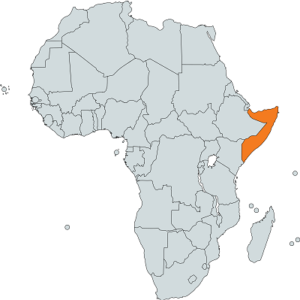
Somalia

Printer-friendly version

Women's Day in Photos from Around the World

A large, energetic crowd turned out on March 8, for Washington, D.C.'s Join Me on the Bridge event. All over the world, women and men commemorated International Women's Day at events affiliated with Women for Women International by gathering on bridges to send the message that we must join together and work collectively to end global violence against women. Below is an audio slideshow narrated by Candice Knezevic, the campaign manager for RAISE Hope for Congo, about D.C.'s Join Me on the Bridge event and other gatherings held around the world.


Exclusive: An Intimate Interview with Supermodel and Activist Iman

The world knows Iman as a supermodel, a successful businesswoman with her own cosmetics company and as a fashion icon alongside her husband David Bowie.

That’s only half the story. Iman also is a refugee whose family fled war in Somalia.

Enough Project Co-founder John Prendergast recently had the chance to sit down with Iman in her New York City office to hear her story. In the exclusive interview in honor of International Women’s Day, Iman talks of leaving Somalia for Kenya, being discovered by a fashion photographer, and finding global fame.

On International Women’s Day, as we celebrate the achievements of women and raise awareness of ongoing injustices against women, Iman’s success story is poignant, especially in light of the causes she fights for, including ending the world's deadliest war in the Congo.

The narrative of Iman's remarkable life directly connects to human rights issues, particularly in Africa, and we are grateful to her for taking the time to sit down with us. Celebrities such as Iman, by sharing their stories, can help inspire new audiences to join the fight against some of the world's worst rights abuses.

Visit our special page to watch the interview.

5 Best Stories You Might Have Missed This Week

Enough Project

Here at Enough, we often swap emails with interesting articles and feature stories that we come across in our favorite publications and on our favorite websites. We wanted to share some of these stories with you as part of our effort to keep you up to date on what you need to know in the world of anti-genocide and crimes against humanity work.

Foreign Policy published an excellent piece late last week about genocide as a national security threat. Michael Abramowitz and Lawrence Woocher laid out a strong case for why the Obama administration should beef up its prevention mechanisms for confronting both genocide and mass atrocities.

Here’s a key graf:

Genocide's negative consequences for the United States are increasingly plain. Mass violence destabilizes countries and entire regions, threatening to spread trafficking in drugs, arms, and persons, as well as infectious disease pandemics and youth radicalization. When prevention fails, the United States invariably foots much of the bill for post-atrocity relief and peacekeeping operations -- to the tune of billions of dollars. And even as Washington is paying, America's soft power is depleted when the world's only superpower stands idle while innocents are systematically slaughtered.

Marcus Bleasdale’s stunning photographs from his new book Rape of a Nation were published in this slideshow on Burn magazine. Bleasdale’s deep familiarity with Congo, a place he has worked for many years, is apparent in the intimacy of this collection.

This feature piece by AP reporter Malkhadir Muhumed describes the use of radio in blasting out Shabaab propaganda on one station – and countering with reports from the fragile U.N.-backed government on another. Loyalty to the government station runs its risks, but as one father of nine said, "I know I'm risking my life. But I need a different point of view.”

In this interview, The Root spotlighted award winning playwright Lynn Nottage, with whom Enough worked last fall to bring a staged reading of her play Ruined to Washington. Nottage talks about the research that went in to writing the play, set in a brothel in modern-day eastern Congo, and what she hopes audiences will take away. As the interview reinforces, she’s an exceptional spokesperson for the Congo cause.

The March/April edition of Foreign Policy magazine includes this exclusive collection of photographs from some of the world’s most acclaimed war photographers. The slideshow includes remarkable testimony from the photographers for added context, often including insights about the scene that was transpiring right outside of the frame.

5 Best Stories You Might Have Missed This Week

Here at Enough, we often swap emails with interesting articles and feature stories that we come across in our favorite publications and on our favorite websites. We wanted to share some of these stories with you as part of our effort to keep you up to date on what you need to know in the world of anti-genocide and crimes against humanity work.

An even less talked about humanitarian crisis brewing as a result of violence in the Democratic Republic of Congo (this time not in the east) comes to life in this BBC slideshow. Fighting in the northwest corner of Congo beginning last October has forced an estimated 100,000 people across the river into the Republic of Congo in just a few short months.

Stunning photographs make this post on the International Rescue Committee’s Voices from the Field a standout of the week. A film crew captured footage among urban refugee communities in Kenya’s capital for an upcoming short film, and this glimpse suggests that it will be visually spectacular film and challenge typical notions of what it means to be a ‘refugee.’

The IRC’s blog also highlighted the benefits of a community-centered program, Tuungane (Swahili for “let’s unite”), in communities in eastern Congo that allocates money to villages according to the projects the villagers themselves decide they want to pursue. Peter Biro’s photos help illustrate the stories of some of the individuals impacted by the program.

In the upcoming print edition of Newsweek, Joshua Kurlantzick of the Council on Foreign Relations offers a dismal overview of governments’ lack of interest in human rights these days: “Obama's waffling [on human rights issues] was hardly unique. Across Europe, Asia, and Latin America, many democracies have abandoned global human-rights advocacy, trotting it out only for occasional speeches or events like International Human Rights Day.” Kurlantzick suggests some (equally depressing but interesting) reasons why the case may be.

An investigative piece by Colum Lynch of the newly launched Turtle Bay blog at Foreign Policy reveals some quiet lobbying on behalf of the notorious military junta leader of Guinea, who stands accused of orchestrating the mass atrocities that took place in the Guinean capital during a peaceful protest last September. The legal advice came from a surprising source.

US Criticized for Somali Aid Restrictions

Anti-government fighter in Somalia - AP

The American government has recently come under fire from the United Nations for its restrictions on aid to Somalia. Accusing the U.S. of politicizing aid, U.N. officials say that by withholding tens of millions of dollars, the U.S. government has prevented humanitarian aid from reaching Somalis in desperate need of food.

In January alone, 63,000 people were displaced in Somalia due to fighting between government forces and militias—this, on the heels of the World Food Program decision to suspend operations (a decision that would cut food aid off to one million Somalis) because of insecurity and militant threats.

U.N. official Mark Bowden said, “What we are seeing is a politicization of humanitarian issues. No U.N. agency has paid any money to al-Shabaab.”

The U.S. decided to hold back funding because of concerns that aid and money were being diverted to al-Shabaab, an Islamist militant group with ties to al-Qaeda that the U.S. has designated a terrorist group. Specifically, U.S. officials believed that contractors in charge of distributing food aid were being forced to pay fees to al-Shabaab in order to access many areas in need.

On Friday, State Department spokesman Philip J. Crowley defended the decision, emphasizing that blame should not fall to the United States or World Food Program:

"The idea that we have somehow politicized aid in Somalia is patently false. If there’s blame to go around here, it is al-Shabaab that – through its attack on the Transitional Federal Government, the checkpoints it’s set up around the country, it is impeding the flow of assistance to millions of Somalis. They’re the ones who are at fault here, and they’re the ones that have caused the UN and the World Food Program to suspend its assistance."

Toward the end of last year, the U.S. made continued aid contingent on U.N. agencies agreeing to monitor deliveries more closely. The U.N. refused, arguing that the restrictions would make distributions nearly impossible.

According to Jeffrey Gettleman of the New York Times, the newest restrictions state that aid agencies receiving U.S. money “cannot pay fees at road blocks, ports, warehouses, airfields, or other transit points” controlled by al-Shabaab – difficult, to say the least, given that the militant group controls more than half of south-central Somalia.

While the Obama administration is clearly concerned about where food aid ultimately ends up, there has been much less attention paid to the lack of restrictions surrounding U.S. military assistance. Though reports from the U.N. and Amnesty International have documented significant arms leakages from the Somali government to the very insurgents they are fighting, the U.S. has only upped its military assistance in the past year.

Last May, the U.S. government applied for an embargo exemption to supply up to $2 million in cash to Mogadishu for the procurement of military materials. During a visit to the region in August, Secretary of State Hillary Clinton pledged strong support for the Transitional Federal Government, amid reports from the State Department that the U.S. had shipped military supplies to the Somali government throughout the spring.


Photo: Anti-government fighter in Mogadishu. (AP)

Technorati Tags:Technorati Tags:

5 Best Stories You Might Have Missed This Week

Enough logo

Here at Enough, we often swap emails with interesting articles and feature stories that we come across in our favorite publications and on our favorite websites. We wanted to share some of these stories with you as part of our effort to keep you up to date on what you need to know in the world of anti-genocide and crimes against humanity work.

Check out this thought-provoking piece by Bill Easterly about a very cute child who grew up to sue the NGO who used his unauthorized photo on a fundraising brochure. Read this one to the end…

Though southern Sudan will likely emerge as the world’s newest country next year, work to prepare for one of the world’s most underdeveloped regions to set off on its own have been severely hampered by bureaucratic hurdles. “[F]ive years after the peace deal was struck [setting up the South for possible independence], donors have provided only $524m, and the region left shattered by 22 years of war and neglect is believed to be the poorest in the world – for the most part without schools, roads, a health service or safe drinking water,” reports the Guardian’s John Vidal from the southern capital of Juba.

Congo’s eastern region suffers from many tragic things, but Colombian researchers are now positing that the guinea pig, beloved pet of American schoolchildren, could hold the key to tackling one of Congo’s ills.

AlJazeera’s Inside Story ran a special feature on Somalia, amid reports that the fragile Transitional Federal Government is on the verge of launching a major offensive against the al-Qaeda-aligned al-Shabaab insurgents and other extremists groups.  Responding to the reports, professor Ahmed Samatar from Macalester College said, “The current regime under [President] Sharif doesn’t’ have the capacity to even win around Mogadishu, let alone around the rest of the country, so I think that it’s a great deal of bravado.” Another guest on the show, Muhdin Mohammed Ali of the U.K.-based Center for Somali Policy, agreed. “The transitional government doesn’t have too many options,” he said. It’s a spirited discussion that gets into theories about the origins of Somalia’s two decades of virtual anarchy.

If you plan to spend any time on African minibuses in the coming months, prep for the experience by checking out this new World Cup-inspired song by Senegalese-American R&B star Akon – Oh Africa. It’s bound to be a fixture on soundtracks blaring from taxis and matatus this summer. (Hat tip: Africa Is A Country)


5 Best Stories You Might Have Missed This Week

Enough logo

Here at Enough, we often swap emails with interesting articles and feature stories that we come across in our favorite publications and on our favorite websites. We wanted to share some of these stories with you as part of our effort to keep you up to date on what you need to know in the world of anti-genocide and crimes against humanity work.

The Kimbanguist Symphony Orchestra and Choir in Congo’s capital of Kinshasa has been frequently featured in the media and in photo essays. Now they’re about to debut at the Berlin Film Festival in the documentary “Kinshasa Symphony” by Claus Wischmann and Martin Baer. From the looks of the trailer, it’s going to be a heartwarming story. (Hat tip: Africa Is A Country)

To mark the start of the 2010 TED conference this week, the social media blog Mashable featured five standout TED talks from years past.  At Enough we constantly look for new ways to shorten the space between the people on the ground in the conflict zones where we work and the U.S. advocates who are dedicated to keeping stories in front of influentials. Writer and professor Clay Shirky’s talk about how social media can make history by empowering citizen journalists is especially relevant – one can easily imagine how the same tools used to report instantly about the 2008 earthquake in China, for instance, could prove powerful during Sudan’s upcoming elections.

Public Radio International ran this short piece by Katy Clark on how the challenges in Haiti have caused aid organizations to necessarily redirect attention away from other crisis zones, at least temporarily. Particularly in tough economic times, the give and take is inevitable, but that doesn’t make it any less unfortunate for places like Somalia.

In this Letter from Congo, the Washington Post’s Stephanie McCrummen describes an unmistakable feature of any eastern Congo cityscape: the wooden, manpowered chukudu scooter that “hauls vegetables in the good times and fleeing people in the bad.

On a related note (though I’m fudging the date because this is funny and timely, given the ICC’s recent prominence in the news), this clip from the Christian Science Monitor’s Scott Baldauf describes a new trend in Kenyan matatu décor. Whose face now adorns the back windows of minivan taxis, a place previously reserved for Barack Obama, American hip hop stars, and statements praising God? Here’s a hint: He’s everyone’s favorite ICC prosecutor.

5 Best Stories You Might Have Missed This Week

Here at Enough, we often swap emails with interesting articles and feature stories that we come across in our favorite publications and on our favorite websites. We wanted to share some of these stories with you as part of our effort to keep you up to date on what you need to know in the world of anti-genocide and crimes against humanity work.

Writing from eastern Congo for the Guardian, David Smith offers a unique view into the peacekeeping mission there, profiling some of the Indian soldiers serving MONUC.  The mission attracts ample criticism for its inability to protect civilians – which is certainly very valid – but Smith’s story describes an actor in the conflict zone that, from afar, we rarely consider: the people underneath the blue helmets.

Another perspective we rarely see (especially for those of us at Enough who can’t get visas to travel beyond southern Sudan) is the view from Khartoum, which photographer Deanna Dent captured in these spectacular shots.

The Guardian also ran this descriptive piece about Somalis fleeing into pockets of relative safety to escape the indiscriminate violence by the al-Shabaab militia. The feature draws in stories of people like Quresh and her baby, newest arrivals in a camp near the town of Burao; “ugly places,” the writer offers. “There are no schools or health facilities. Not even proper sanitation. Privately owned, the residents are charged to occupy their huts and draw water from the solitary well.” As the author witnesses during his short stay at Burao, new hardships often befall even those people fortunate enough to escape the violence that initially forced them from their homes. Many of Somalia’s 1.3 million internally displaced people have had to flee multiple times.

In much of Central Africa, the Red Cross is taking the lead to try to reunite families separated in conflict. Often, parents lose their children in the chaos of fleeing to safety, and the process to reconnect them can be challenging and, as this short video
shows through the story of two families, bittersweet.

To end the week on a lighter note, Foreign Policy’s Elizabeth Dickinson puts a spin on the Oscar nominations, coming up with a “best of” in foreign affairs 2009. Dickinson makes a compelling case for some of this year’s nominees, but FP is taking nominations and votes from the public too.

Amnesty Spotlights Shoddy U.S. Military Assistance To Somalia

U.S. policymakers would do well to take note of the latest report from Amnesty International which outlines the serious civilian consequences that may result from indelicate military assistance to Somalia. The group warned last week that despite the steady flow of internationally-supplied arms to Somalia this past year, disturbingly few safeguards are in place to ensure that those weapons are not being used for war crimes and serious violations of international humanitarian law.

The “lack of international human rights standards and effective accountability” surrounding assistance to the Somali government, or TFG, risks exacerbating the broiling conflict. The report said:

“…[D]onors’ concern for the viability of the TFG and the security of international shipping has not been matched by equal attention to the human rights of the Somali people and the protection of civilians in the continuing armed conflict.”

Though Ethiopia, Yemen, and Uganda number as the most egregious international actors when it comes to supplying weapons, U.S. assistance to Somalia is also a cause for concern. In particular, U.N. monitors have been unable to trace the path of U.S.-supplied arms, or to detect whether any of the weaponry has been diverted to other armed groups, because of the lack of detail the U.S. government provides.

This difficulty tracing would not be so alarming if the Somali government didn’t have problems in the past controlling equipment leakages. In a 2008 report, U.N. monitors documented the diversion of internationally-supplied weapons and military equipment from the TFG to armed opposition groups—the very ones that the Somali government is fighting.

Amnesty also documents U.S. plans to supply up to $2 million to the Somali government for the purchase of military supplies “locally,” a move that that risks supporting Somalia’s domestic arms trade:

“…[T]he funding of purchases from domestic arms traders will help to support Mogadishu’s flourishing, uncontrolled domestic arms markets: the same markets that are reportedly a major source of weaponry for al-Shabaab and other armed groups opposed to the TFG, and themselves accused of committing war crimes and other serious human rights abuses." 

This lack of transparency also extends to international assistance in military and police training, where the selection of trainees, trainers, and even what practices the Somali forces are trained in, may be problematic when held to international human rights standards.

The risk that foreign assistance may ultimately prolong the violence in Somalia is a serious charge that international donors must heed. Without establishing the proper mechanisms to monitor where and how military assistance is used, the international community will certainly be failing the most important group of actors concerned — the Somali civilians caught in the crossfire. 


Photo: Anti-government fighter in Mogadishu (AP)

Technorati Tags:Technorati Tags:

In January Alone, 63,000 People Displaced in Somalia

Click here to see the full U.N. map.

The new year has certainly not brought about improvements on the ground in Somalia, with the latest report from the U.N. refugee agency finding that a staggering 63,000 people have already been displaced this year due to ongoing violence.

The massive displacement stems from conflict that has erupted in central and southern Somalia since the start of the year. Most recently, fighting broke out in the capital of Mogadishu between Somali government forces and two militias, al-Shabaab and Hizbul Islam. This violence has displaced an estimated 14,000 people over the last two weeks; 10 people, including children, were killed.

Fighting also broke out earlier in the month between government-aligned militia Al Sunna Wal Jamma and Hizbul Islam in Beledweyne. According to the U.N. refugee agency, 11,900 were displaced and are temporarily settled around the central Somali city. In the nearby city of Dhuusamarreeb clashes between Alu Sunna Wal Jamma and al-Shabaab displaced 28,800. U.N. spokeswoman Melissa Fleming said the displaced are in urgent need of shelter, water, and care.

This new influx of displaced people is joining the ranks of countless Somalis who have already been forced to flee from their homes—as of September 2009, there were almost 400,000 IDPs just in and around Mogadishu. The spike in numbers will compound an already desperate situation in which aid agencies have limited access to a population that suffers from constant attacks, sexual violence, child recruitment, and a lack of basic necessities. Earlier this month, the World Food Program, the U.N.’s food relief program, suspended its operations in much of south and central Somalia due to militant threats, adding the potential of starvation to the litany of problems plaguing the population. In total, Somalia has a huge internally displaced population of 1.5 million.

It was good to see that the Associated Press, for one, found it important to pick up on the story. As Foreign Policy’s Josh Keating aptly noted on Twitter yesterday, “When are 63,000 displaced people in one month not a HUGE story? When they're in Somalia."

Technorati Tags:Technorati Tags: