

Though Enough’s work focuses on ending and preventing mass atrocities, it is important not to lose sight of the inspiring news coming out of the conflict areas we follow. Every four years the world’s countries come together in a celebration of sport, and we are reminded that even for athletes from the most war-torn regions, records can be broken, new precedents set, and dreams can come true.
The Olympic Truce, originally instituted in the 9th century Greek Olympic Games, and adopted by the International Olympic Committee, or IOC, and United Nations in 1992 aims to:
- Mobilize youth for the promotion of the Olympic ideals;
- Use sport to establish contacts between communities in conflict; and
- Offer humanitarian support in countries at war; and more generally: to create a window of opportunities for dialogue and reconciliation.
Despite extensive domestic conflict, athletes from Sudan and South Sudan are competing in the London 2012 Olympic Games.
South Sudan in the Olympics
South Sudan became the world’s newest country in July 2011. Like all members of the United Nations, it was automatically accepted into the IOC, but South Sudan was unable to organize its own National Olympic Committee, or NOC, in time for London 2012, and therefore cannot send athletes to the games.
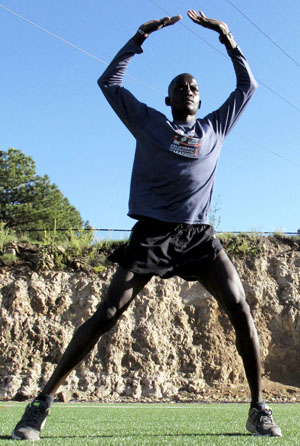
Because of this delay, the IOC granted South Sudanese athletes permission to compete under the flag of their former country, Sudan. However, for South Sudanese marathoner Guor Marial, running for the government that is responsible for the deaths of 28 of his family members was an unacceptable option. Marial was granted permission by the IOC to run as an independent athlete under the Olympic flag.
Marial was forced to flee his home in South Sudan’s Unity state when he was 8 years old and gained refugee status in the U.S. when he was 16 years old. Marial currently lives and trains in Flagstaff, Arizona, and ran his first marathon in 2:12:55 in October 2011. His time bested the Olympic A standard qualifying time of 2:19:00, making him eligible to compete in the Olympic Games.
"I'm running for the refugees,” says Marial, “And I'm running for the South Sudanese, especially."
Possibly the most famous South Sudanese athlete competing in London is Lopez Lomong. This 5,000-meter runner is one of the “Lost Boys of Sudan,” who came to the U.S. in 2001 when he was 16 years old. He is now an American citizen and competes for the United States. Lomong carried the flag for the U.S. Olympic team in the opening ceremonies in Beijing and will compete in the 5,000-meter race on August 8.
Sudan in the Olympics
Sudan is fielding a team of six athletes at these games: three 800-meter runners, one 400-meter runner, and two 50-meter freestyle swimmers.
In track and field, Ismail Ahmed Ismail ran in the first round of the 800-meters on Monday, August 6, but did not qualify for the semifinals. Ismail, who lives in Khartoum but is originally from the Fur tribe in Darfur, has an impressive Olympic history. He competed in Athens at the age of 19, and in Beijing in 2008 he won silver in the 800-meters, becoming the first Sudanese athlete to ever win a medal.
It has been reported that on the eve of the opening ceremonies in London, Ismail walked into a police station and requested political asylum. However the Sudanese embassy denied the report and maintained that he will still run the 800-meters for Sudan.
Abubaker Kaki Khamis is another Sudanese 800-meter Olympic veteran. He did not make it to the finals in Beijing but is a two-time World Indoor 800-meter champion and won gold at the 2007 All-Africa Games. In London this year he won his 800-meter heat in Round 1 which advanced him to the semifinals on August 7. In the semifinals he again won his heat, running 1:44.51, and will compete in the finals on August 9.
Rabah Yousif is Sudan’s only 400-meter runner competing in the London Olympics. He comes from a family of Sudanese athletes – his father was a 100- and 200-meter national champion, and two of his uncles were runners and the other a shot-putter. In 2002 while at a training camp in the U.K, Yousif asked for and was granted asylum for 2 ½ years while he was still a minor. Despite his successes in U.K. running, Yousif’s application to gain refugee status was rejected after a 5-year battle, and he returned to Sudan in 2008.
He competed for Sudan in Beijing in 2008, and in London this year he made it to the 400-meter semifinals on August 5 but did not advance to the finals.
Sudan has a one-woman female track and field team: Amina Bakhit will compete in the 800- meters on Wednesday, August 8.
Sudan’s two swimmers competed in the 50-meter freestyle in the London Games: one man, Mohamed Elkhedr, who placed 50th out of 58 in the heats, and one woman, 18-year-old Mhasin Fadlalla, who placed 70th out of 73 competitors in the first round of heats last week.
Photo: South Sudanese runner Guor Marial opted to run as an independent athlete rather than compete for Sudan (AP)