
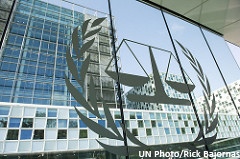
The issuance of an arrest warrant for Sudan’s sitting head of state for crimes against humanity offers the Obama administration a chance to catalyze multilateral efforts to bring about a solution to Sudan’s decades-long cycle of warfare. One of the crucial missing ingredients to conflict resolution efforts has been some form of accountability for the horrific crimes against humanity that have been perpetrated by the warring parties in Sudan, primarily the Khartoum regime. Peace without justice in Sudan would only bring an illusion of stability, without addressing the primary forces driving the conflict.
The issuance of an arrest warrant for Sudan’s sitting head of state for crimes against humanity offers the Obama administration a chance to catalyze multilateral efforts to bring about a solution to Sudan’s decades-long cycle of warfare. One of the crucial missing ingredients to conflict resolution efforts has been some form of accountability for the horrific crimes against humanity that have been perpetrated by the warring parties in Sudan, primarily the Khartoum regime. Peace without justice in Sudan would only bring an illusion of stability without addressing the primary forces driving the conflict.
The decision by the Pre-Trial Chamber of the International Criminal Court, or ICC, to issue an arrest warrant for Sudanese President Omar al-Bashir is unsurprising given the long pattern of profound abuses in Sudan directed from the highest echelons of government. Over the past several weeks, President Bashir has escalated violence in Darfur and increased human rights violations in Khartoum in a last-ditch effort to force the United Nations Security Council to defer the ICC’s investigation for one year “in the interest of peace.”1 However, as Enough argued when ICC Chief Prosecutor Luis Moreno Ocampo requested the warrant in July 2008, the prior indictments of former Liberian President Charles Taylor and former Serbian President Slobodan Milosevic demonstrate that the pursuit of justice can be a catalyst for peace—if the international community stands resolutely behind efforts to promote accountability for genocide and crimes against humanity.2 The situation in Sudan is no different. Senior officials within Bashir’s National Congress Party, or NCP, are deeply concerned about the possibility of further charges by the ICC, and a growing fissure between Bashir’s loyalists and potentially more pragmatic elements of the NCP could lead to the president’s removal.
To ensure that any potential leadership change within the regime will actually produce meaningful movement toward peace on the ground, the international community must fashion a firm and coordinated peace strategy conditioned on actions rather than words and policies rather than personalities. What should be clear to the international community, including the United States, is that President Bashir should be delivered to the court to face a fair trial on the charges against him. Furthermore, the international community needs to use multilateral diplomacy, well targeted pressures, and judicious incentives to bring both the NCP and Darfur’s rebel groups to the negotiating table, while making a major effort to revitalize the 2005 Comprehensive Peace Agreement, or CPA, as part of a broader and more strategic peace effort for all of Sudan.
How the warrant affects the key actors in Sudan
Sudan is teetering on a dangerous precipice: Violence in Darfur is escalating and CPA implementation is faltering. An NCP-backed coup attempt in neighboring Chad seems increasingly likely. (Rebels supported by Khartoum have reached the capital N’Djamena twice already, in 2006 and 2008). The response of key actors in Sudan to the ICC’s move against Bashir is still obviously a work in progress, but the choices made in the coming weeks by the NCP, as well as the main rebel groups in Darfur, and the Sudan People’s Liberation Movement, or SPLM, will have profound impact on the country’s future. Understanding the calculations of these actors is fundamental to leveraging the arrest warrant into progress toward peace.
The National Congress Party
Sudan’s ruling NCP has faced substantial pressures both from within and without in anticipation of the warrant against Bashir. Internally, Bashir and his loyalists face growing opposition from a group led by Sudan’s Second Vice President Ali Osman Taha, its intelligence chief Salah Abdullah Gosh, and its energy minister Dr. Awad al-Jaz. Tensions between the two camps have been mounting for months, and Gosh blames Bashir and his senior advisor Nafie Ali Nafie for Sudan’s increasing international isolation.
With the warrant now out in the open, this jostling between these two main factions will likely intensify and could split the party. Although Bashir, an army general, still commands loyalty within the regular armed forces, this rival alliance is represented by powerful actors in Sudan’s political, security, and economic sectors. Taha and Gosh bear significant responsibility for crimes against humanity committed during the regime’s 20-year rule, yet they have shown willingness to work with the international community. Taha was the NCP’s point person in negotiating the CPA, and Gosh has become the United States’ favored interlocutor on counterterrorism. Within a ruling party increasingly focused on its own survival, Bashir may become a sacrificial lamb for a party in search of more pragmatic leadership.
Externally, Bashir’s efforts to force a deferral of the ICC investigation have run aground, and the new Obama administration has already raised the possibility of additional punitive measures against the regime. The African Union, the Arab League, and China have all maintained vocal support for a deferral, but the United States’ outspoken opposition has effectively neutralized these efforts.
Furthermore, the recent government attacks in Darfur have made it difficult for even some of Bashir’s most loyal allies to use their typical arguments while seeking to defer justice. In the weeks leading up to the arrest warrant, some of the regime’s most stalwart allies already began distancing themselves from Khartoum. Most important is Egypt, which for years used its influence in the Arab League to rally support for Bashir’s government. However, relations between the two countries have cooled since Egyptian President Hosni Mubarak met Bashir in Khartoum in November 2008. According to Sudanese officials, Mubarak called Bashir to task for failing to implement the CPA and for driving the South toward independence, a situation that would complicate maintaining the uninterrupted flow of the Nile River, Egypt’s main interest in Sudan. Mubarak also voiced concerns that the Sudanese Islamist movement is the gravest security threat in the region, and blamed the Sudanese government for instability in Chad, and the continued predations of the Lord’s Resistance Army, or LRA. If Egypt expresses a willingness to accept new leadership in Khartoum, other allies in the Arab world will likely follow suit, further weakening Bashir’s internal position.
Given these internal and external pressures as well as the regime’s historic patterns of behavior, there are three likely scenarios for how the NCP will react to the indictment:
Scenario one—President Bashir opts for confrontation with the international community: By intensifying the aggressive crackdown in Darfur that he began in Muhajiriya in advance of the warrant, increasing aerial bombardments of civilians, restricting or expelling humanitarians and peacekeepers, stepping up support for Chadian rebels, threatening to withdraw from the CPA, or backtracking on counterterrorism cooperation, Bashir could force the international community to take more assertive action or back down. At the same time, Bashir could work internally to assert firm control of the NCP by jailing opponents, imposing martial law, and increasing military presence in Khartoum and elsewhere. While many humanitarians and U.N. officials have expressed deep concerns about this scenario, it is important to note that such maximalist behavior by Bashir would only serve to further galvanize international support for decisive action against his government.
Scenario two—Internal pressure forces Bashir from office: Given the mounting pressure from within, Bashir could decide to peacefully step aside and cede control to a new NCP candidate, who would participate in the upcoming national elections. Alternatively, rivals within the party could attempt to take power by force. Salah Gosh is one of the strongest advocates for removing Bashir, and Sudan is no stranger to coup d’états. However, Bashir has reportedly told Gosh that he may step down if the divisions within the NCP become irreconcilable. Some Sudanese officials have cited the possibility of exile in Saudi Arabia, which is not a party to the ICC. The new leadership of the NCP could then adopt a more pragmatic approach to the international community by negotiating an end to the war in Darfur and recommitting itself—although unenthusiastically—to the CPA. Bashir’s peaceful departure would undoubtedly be in the best interests of the NCP and the country as a whole, but some Bashir loyalists have threatened to kill Vice President Ali Osman Taha if any attempt is made to remove Bashir from power. Here again, it is important to note that after charges were brought against both Charles Taylor and Slobodan Milosevic much was made of the fact that there was no clear mechanism to deliver them to The Hague—yet that is exactly where both men eventually found themselves. This was in large part because in both cases loyalists recognized the increasingly steep cost of resisting international norms on an issue as fundamental as crimes against humanity.
Scenario three—Bashir stalls for time: After years of what the new U.S. Ambassador to the United Nations Susan Rice calls “bluster and retreat,” by the international community, Bashir may well calculate that the pressure arising from the arrest warrant will eventually dissipate. The NCP has weathered heavy external pressure in the past and survived by exploiting the inherent divisions in the international community. It may be entirely possible that Bashir, rather than take dramatic action in response to the warrant, will bide his time, and commit the bulk of his energy and resources to facing internal challenges.
The Darfur rebel groups
Bashir’s indictment fundamentally alters the context for Darfur’s rebel groups, presenting a rare opportunity for the more politically savvy groups in the region to gain some legitimacy at the expense of the regime. Darfur’s most significant rebel group, the Justice and Equality Movement, or JEM, supports the issuance of an arrest warrant. At the same time, however, Mr. Ocampo is pursuing cases against the rebels, and the leaders of the JEM and the various factions of the Sudan Liberation Army, or SLA, have to weigh their support of a warrant for Bashir against the possibility that they are potentially subject to a similar fate.
Given the JEM’s dominant military and political status vis-à-vis the other rebel groups, its response to the warrant will strongly influence other rebels. The JEM’s recent behavior—renewed military offensives, bellicose threats against the government, and overtures to the international community—suggests that the rebels are keeping their options open. Although the JEM took control of Muhajiriya, South Darfur, by force in late January, the rebels withdrew when Khartoum requested that peacekeepers from the joint United Nations/African Union mission, or UNAMID, leave the area and threatened to level the town. Afterward, JEM leader Khalil Ibrahim met in the Chadian capital N’Djamena with a senior UNAMID official and stated that the JEM is “willing to establish a working relationship with UNAMID for the protection of civilians.”3
The JEM’s gesture toward UNAMID, a recent JEM visit to the United States (at the invitation of the outgoing Bush administration), and its decision to participate in “talks about talks” in Qatar suggest a broad effort to present itself as a credible political actor. However, the JEM continues to warn of greater military action down the road, including another attack on Khartoum if Bashir’s indictment leads to “chaos.”4 Although government forces routed the rebels when they attacked the Khartoum suburb of Omdurman last May, the JEM could seek to rally support for a new offensive meant to remove a president charged with war crimes from power. Provoking a heavy-handed response from the Sudanese government could also be a way to force external actors—particularly the United States—to increase pressure on the regime and potentially take military action to protect civilians against wholesale casualties. Generating a threat of force from the international community to buttress one’s own strength is nothing new: The Kosovo Liberation Army used this tactic to great effect during the run-up to NATO’s intervention in Kosovo in 1999.
The Sudan People’s Liberation Movement
The SPLM is largely in reactive mode, and senior officials within the party disagree on the possible effect of the arrest warrant. Salva Kiir, the president of the Government of Southern Sudan and Sudan’s first vice president in the national unity government, is deeply concerned that Bashir’s indictment signals the end of the CPA. Other SPLM officials are optimistic that second Vice President Ali Osman Taha will remove Bashir and recommit the NCP to CPA implementation. Taha’s influence has diminished since the death of SPLM leader John Garang, and the NCP has sought to undermine CPA implementation. Yet many within the SPLM believe that Taha understands the importance of the CPA to the survival of his party, and that he will make some sacrifices—as he did while negotiating the CPA—to keep the deal on track. If Bashir were to step down, the new NCP leadership would have to work with the SPLM to reorganize the government of national unity, which an interim president would lead until elections and the formation of a new government.
Next steps for the Obama administration
Although no one can accurately predict how various actors in Sudan will respond to the warrant for Bashir, the international community, including the Obama administration can—through effective multilateral diplomacy, a willingness to call Bashir’s bluff, and practical steps to increase pressure on Khartoum in pursuit of a comprehensive peace deal that includes both Darfur and revitalized CPA implementation—make the pursuit of peace the most attractive option for the NCP and Darfur’s rebel groups. The Obama administration’s response to the immediate challenge posed by the warrant should take into account the calculations and possible scenarios discussed above, but it should also flow from answers to broader and more strategic questions: What is the end game? What is the overall strategic goal? And what level of force is the administration and its allies willing to use, if the Sudanese government chooses to escalate confrontation? Answering these big picture questions up front is fundamental since many of the tactical responses to the situation on the ground and arrest warrant could inexorably lead to a much higher stakes game.
A comprehensive policy approach to Sudan must include several components:
Consistent high-level diplomacy: Given the scale and complexity of the crisis in Sudan, the president should appoint a special envoy to serve as the United States’ point person on Sudan policy and lead U.S. efforts to forge a multilateral coalition that supports more robust measures to help end the war in Darfur and ensure full implementation of the CPA. This envoy must have direct access to President Obama, and appropriate staff and resources, including authority over the State Department’s Sudan Programs Group. This envoy would need a dedicated team and sufficient resources to carry out his or her work.
Firm messaging to the NCP: Messages should be conveyed to the key actors within the NCP both publicly and privately. In terms of public messages, the administration should make it clear that it fully supports justice and accountability for Darfur’s genocide, and will not tolerate any obstruction of aid efforts, deployment of UNAMID, or implementation of the CPA. There will be consequences for such actions that will directly affect the leadership of those entities party to the conflict. Behind-the-scenes, the United States must make clear that continued attacks on civilians or peacekeepers, the anticipated proxy coup attempt in Chad, or efforts to cut off humanitarian aid will be viewed as a major escalation of hostilities by Khartoum and will be treated as such by Washington and its allies. Any credible peace effort will demand an unconditional ceasefire and a peace deal in Darfur that includes accountability mechanisms broadly acceptable to Darfuri citizens, real movement on CPA implementation, and the demonstrable return of large numbers of Darfuri IDPs and refugees to a secure environment.
Firm messaging to the rebels: The Obama administration should make clear to Darfur’s rebel groups that it and the international community will apply a common set of standards to all sides of the Darfur conflict. The U.S. envoy should make clear to JEM and others that the international community will hold rebels accountable for crimes against humanity and that attempts to provoke external intervention will be met with consequences.
Contingency planning: The Obama administration must take steps to detach humanitarian and peacekeeping operations from dependence on Khartoum. Contingency plans should be established to reposition all non-life-saving personnel, and to provide life- saving programs in non-permissive environments. The United States should consider providing air assets and logistical support to facilitate these steps if needed, and Washington’s allies should consider similar measures. Too often, UNAMID has been left in the position of pleading with the Sudanese government and rebels not to be a target of attacks. UNAMID should be in a position to respond with decisive force to provocations from any side and to effectively protect civilians. Until it can meet those basic standards, it cannot be considered an effective peacekeeping mission.
Clear consequences: The international community should establish clear consequences if Sudan fails to deliver Bashir to justice. These measures should include rapid escalation of targeted sanctions, an expanded arms embargo, imposition of an oil blockade on Port Sudan, and targeted airstrikes against air assets used by the regime for offensive military operations, with escalating strikes against military and government installations if there is continued intransigence. To that end, the Obama administration should task Pentagon and NATO planners with developing options for a multinational force to carry out the military options outlined above. Such a force could also temporarily buttress UNAMID by providing the robust command-and-control capabilities UNAMID currently lacks and badly needs.
Direct diplomacy with the SPLM: Although more robust measures aimed at Khartoum carry risks to the CPA, the United States ought to reaffirm its commitment to southern self-determination and take advantage of the SPLM’s role in the national unity government to encourage more pragmatic elements within the NCP to step forward.
Deeper engagement with China: The Obama administration should engage more deeply with the Chinese to make clear that the U.S. goal in Sudan is stability and lasting peace—goals which Beijing should also support and which the two countries could work together to secure. An American envoy should invite closer collaboration between the United States and China in support of Darfur peace and CPA implementation. Bashir is increasingly an obstacle to those goals and his behavior risks creating more danger and instability for the international community.
An historic choice
The situation in Darfur is changing daily, and it is impossible to predict what will occur in the immediate post-warrant period within the ranks of the NCP and among the key rebel factions. One thing, however, is certain: This is a moment of opportunity during which the United States has a crucially important choice to make. It can help lead the international community in the pursuit of a credible and strategic approach to peace and justice, or it can let the situation worsen absent serious pressure from outside actors. Now is the time for the Obama administration to follow through on its promises to end the crisis in Darfur and lead international efforts toward a peaceful future in Sudan.
Endnotes
1 Article 16 of the Rome Statute of the International Criminal Court provides that “[n]o investigation or prosecution may be commenced or proceeded with under this Statute for a period of 12 months after the Security Council, in a resolution adopted under Chapter VII of the Charter of the United Nations, has requested the Court to that effect; that request may be renewed by the Council under the same conditions.” The Sudanese government so far has failed in getting Security Council support for a 12-month suspension of the investigation, in large part because of the dismal situation on the ground in Darfur and the government’s lack of seriousness in addressing the peace process. 2 See Enough’s strategy paper by John Norris, John Prendergast, and David Sullivan, “The Merits of Justice” (July 2008). 3 See ReliefWeb, “UNAMID JSR Adada meets with JEM Chairman in N’Djamena, Chad,” February 5, 2009. 4 See “Darfur JEM claims free reign in the region, warns government,” Sudan Tribune, January 31, 2009
Last Updated: March 08. 2010 8:41PM UAE / March 8. 2010 4:41PM GMT
NAIROBI // One year after Omar al Bashir, the Sudanese president, was indicted for war crimes in the western Darfur region, the violence there continues to linger. Clashes have erupted in the past week despite a ceasefire deal signed last month between the government and a major rebel group.
As the international community shifts focus to the tense standoff between north and south Sudan before next month’s elections, observers are worried that the country could see a return to fighting in Darfur.
At least 300,000 have been killed in Darfur and millions displaced since fighting began in 2003, according to the United Nations. Khartoum says 10,000 have been killed. The latest fighting has left a further 100,000 in flight.
Last year, the International Criminal Court in The Hague issued an arrest warrant for Mr al Bashir for crimes against humanity. Genocide charges remain possible. In response, Mr al Bashir kicked out 13 international aid organisations operating in Darfur.
The concept behind the Arrow Boys preceded the LRA’s most recent arrival in Sudan. Originally, the Ugandan government, seeing its shortcomings in combating the LRA, supported the creation of the Arrow Boys in northern Uganda to protect the local communities. The title of this local militia came from the primary weapon used by its members. In southern Sudan, the Arrow Boys seem to have sprung up more spontaneously.
Author:
Laura Heaton and Maggie Fick
Mar 11, 2010
YAMBIO, Western Equatoria, Southern Sudan— “Omer Bashir,” Adrian said, emphatically responding to the question we posed to our local interpreter without waiting for the Zande translation. We had asked who he thought was behind the recent attacks by the Lord’s Resistance Army, or LRA, on his community in southern Sudan. “They have been sent. They have been bribed, told to kill the people on this land,” he said. Eight months ago, this 23-year-old—his youthful face hiding the horrors he has witnessed—fled with many others from his village to the largest town in this remote corner of southern Sudan near the Congolese border. Adrian and his fellow villagers now live on land owned by the local Episcopal Church, and have begun building basic homes and cultivating the land.
But after speaking to Adrian and other men in this makeshift village of displaced and traumatized survivors of LRA attacks, it’s clear that they don’t plan to simply wait out the storm. In the absence of an effective response by the Sudanese government to the LRA, many local men and boys have taken community security into their own hands. They are part of a loose-knit, meagerly armed, local defense force called the Arrow Boys.
The Enemy
The LRA is a brutal, predatory militia that originated in northern Uganda in 1986 and has terrorized civilian populations across central Africa ever since. In December 2008, a U.S.- backed military operation by the governments of Southern Sudan, Democratic Republic of the Congo, and Uganda, known as Operation Lightning Thunder, attempted to destroy the LRA’s command center based at the time in Garamba National Park in northeastern Congo. Since this offensive, the LRA has moved north from Garamba, fanning out across the dense forests of northeastern Congo, Sudan’s Western Equatoria state, and neighboring Central African Republic. Credible reports by the Ugandan and southern Sudanese armies suggest that members of the LRA are taking refuge (and seeking to resupply) in South Darfur.
The International Criminal Court issued arrest warrants for the LRA’s messianic leader Kony and two of his commanders for crimes against humanity, but they remain at-large. Anecdotal evidence suggests that the historic link between the LRA and the ruling National Congress Party in Khartoum, thought to have tapered off in recent years, may have been revived. In the minds of Adrian and many of the rank-and-file Arrow Boys operating in southern Sudan, there’s no doubt of this connection.
Enough’s LRA researcher Ledio Cakaj recently documented the failuresof the SPLA and the United Nations Mission in Sudan, to protect civilians in Western Equatoria, where a string of ongoing LRA attacks displaced more than 80,000 Sudanese people in 2009. Decentralized and on the move, the LRA has been particularly lethal in recent months, with little standing in their way – except civilian populations. “They are even more dangerous now that they are in small groups,” said Sister Giovanna, an Italian nun in the town of Nzara (20 kilometers from Yambio) who lived in northern Uganda during the height of the LRA violence there.
Mobilizing, Seeking Support, and Taking Action
The concept behind the Arrow Boys preceded the LRA’s most recent arrival in Sudan. Originally, the Ugandan government, seeing its shortcomings in combating the LRA, supported the creation of the Arrow Boys in northern Uganda to protect the local communities, particularly vulnerable camps of displaced people. The title of this local militia came from the primary weapon used by its members. (Watch for an upcoming blog post on the history of the Arrow Boys in Uganda.)
In southern Sudan, the Arrow Boys seem to have sprung up more spontaneously.
The regional leader of the Arrow Boys, who asked for his name not to be used for security reasons, explained that after watching the LRA ravage their communities, southern Sudanese men and boys decided to respond.
“Very many people have died, and many others have had to flee their homes. […] We came with the mind of how to provide security for those that are here and end that threat [of the LRA],” he said.
“When I saw that kind of killing—they could crash the heads of your sons and daughters so they can’t even be recognized—it pained my heart,” said the leader of one group of Arrow Boys. “It depends on the heart. Any boy can be an Arrow Boy,” he said.
Having logged some victories against the LRA and won the support of their local communities and churches, the Arrow Boys turned to the government of Western Equatoria State for endorsement. As a show of solidarity, church leaders and government officials, including Western Equatoria governor Jemma Kumba, participated in a march in September 2009to raise awareness about the LRA threat in the state. Their protest generated national and international attention, and the Government of Southern Sudan, or GoSS, pledged to send additional troops to fend off the predatory militia and defend the local population. But, attacks have continued. Since then, the government has stayed engaged with the Arrow Boys, though the nature of its support remains ambiguous. Some Arrow Boys Enough spoke to claimed that they have received bullets from Sudanese soldiers from time to time, but local and state government officials insist that they are not arming the Arrow Boys; rather, the government has given them permission to operate and convinced GoSS to postpone a scheduled civilian disarmament campaign in Western Equatoria so that its civilians can continue to defend themselves.
Local government sources frame the Arrow Boys as part of an organized counterinsurgency strategy. Col. Joseph Ngere, the Deputy Governor and Minister of Information in Western Equatoria, credited the Arrow Boys with being well placed to produce intelligence for the government. “In terms of information collection, it is not possible to have the army on every border,” Col. Ngere said. “The Arrow Boys know the land well so they should help.” Yambio County Commissioner David Billy reinforced this perspective. He was complimentary of their contribution to the fight but maintained that the Arrow Boys are “not given the power to do things by themselves. They are not engaging on the front line.”
However, visiting areas recently targeted by the LRA, neither the Arrow Boys nor members of their communities gave the impression that their fathers, sons, and brothers are simply feeding information to the army and clearing the way for the Sudanese soldiers to confront the militia. While coordination between the SPLA and the Arrow Boys would almost certainly bolster civilian protection in Western Equatoria, it seems that this collaboration has yet to be fully optimized.
Creative Community Security Measures
With their local guns that shoot only one bullet before needing to be reloaded and their handmade bows and arrows, the Arrow Boys may not seem to be militarily matched to the LRA and their sophisticated weapons. What the Arrow Boys have on their side, though, is the ability to counter one of the LRA’s primary tactics: surprise. The LRA doesn’t expect any resistance, they don’t expect people to fight back,” said an employee of an international organization working in Western Equatoria. Using a system that resembles a neighborhood phone tree, the Arrow Boys stay connected through cell phones dispersed strategically among the leaders of their ranks. They quickly mobilize to reinforce their comrades when the LRA is spotted in the area.
Another advantage that the Arrow Boys use to better protect their communities is their knowledge of the area. Given their familiarity with the terrain, the Arrow Boys can predict which routes the LRA will take and stake them out, capturing or killing LRA who fall into their ambush. In one area Enough visited, groups of 15-20 Arrow Boys take turns conducting nightly patrols, arguably the most important practice of protecting civilians from the LRA. The Arrow Boys and their sympathizers also keep in close touch with both southern Sudanese and Ugandan army contacts in the region. “I never thought a cell phone could be so useful. Thank God that Zain [cell network] is here now,” said Sister Giovanna, underscoring the tremendous impact basic technology can have on grassroots, civilian protection.
The regional leader of the Arrow Boys described how his group coordinates with village leaders to keep track of the people who come and go. They can gauge the approximate location of the LRA based on information from displaced people who arrive from sites of fresh LRA attacks. In partnership with village elders, the Arrow Boys also spread information about the tactics of the LRA so that local communities can do their best to remain alert and attempt to avoid succumbing to ploys the LRA use to gain access to the communities. One known maneuver is pretending to surrender – a tactic that recently led to the death of five civilians in a village we visited.
Local Security or a Budding Militia?
“We support them, but the idea is not to create another militia,” said the deputy governor of Western Equatoria. “The Arrow Boys are under our control,” said County Commissioner Billy.
The men and teenage boys we interviewed in displaced persons settlements and on the outskirts of insecure villages that have seen multiple LRA attacks do not resemble hardened militiamen or battle-ready soldiers. They are mainly farmers in an area that saw little fighting during the violent North-South civil war in Sudan. The Arrow Boys insist that they will disband as soon as the threat of the LRA subsides in their own communities. “We have only one plan, which is to provide security just here, because it is very hard for us to continue following [the LRA],” said the regional Arrow Boys leader. They don’t have the resources or the organizational structure to pursue the LRA farther afield, he said, acknowledging reports that the LRA may be moving north toward Darfur. “What we normally do is just to keep security here tight and provide a defense system to our own people.”
But as the scope of the Arrow Boys’ operations expand to include other policing duties, like rounding up local drunkards and troublemakers, and the public perception of a southern Sudanese government unable or unwilling to confront the LRA threat persists, the Arrow Boys seem to be making themselves increasingly indispensable. Should some sub-group or powerful local leader within the Arrow Boys decide that the group should broaden its mandate and extend its existence beyond the horizon of the LRA threat, many complicated questions will arise. Who will attempt to disband and disarm the Arrow Boys (and how)? What will the impact be of the dissolution of the Arrow Boys—largely made up of men and boys who may have found ways to profit from their membership in this group, and who may be reluctant to relinquish their status as defenders of their communities?
Apart from the LRA violence, we heard much talk of tension in Western Equatoria state between the agrarian Azande people and the cattle-keeping Dinka and Mbororo groups. “It is the other small sickness, the virus, in southern Sudan,” said Adrian, reflecting on just one of the numerous, deep internal ethnic fissures in southern Sudan. Whether the LRA moves away from Western Equatoria on its own volition, or the Arrow Boys help to push the LRA out of this territory, one can already anticipate a possible future source of instability – indeed, so-called ‘tribal clashes’ killed more than 2,500 people last year in other parts of southern Sudan. Given the history of proxy warfare in Sudan, it’s not difficult to imagine how the government in Khartoum might exploit these local rivalries following the exodus of the LRA from the region.
The Lord’s Resistance Army, or LRA, continues to pose a severe threat to civilians in northeastern Democratic Republic of the Congo. Since the LRA began attacking civilians on Congolese soil in September of 2008 through the end of 2009, it has killed approximately 1,800 civilians, with 300 deaths during December 2009. More than 100 people were killed during January 2010.
Enough field researcher Ledio Cakaj details the abuses of both the Lord's Resistance Army militia and the Congolese Army against civilians in Congo.
The Lord’s Resistance Army, or LRA, continues to pose a severe threat to civilians in northeastern Democratic Republic of the Congo.[1] Since the LRA began attacking civilians on Congolese soil in September of 2008 through the end of 2009, it has killed approximately 1,800 civilians, [2] with 300 deaths during December 2009.[3] More than 100 people were killed during January 2010.[4]
Units from the Congolese national army, or FARDC, sent to protect civilians and fight the LRA have shown little interest in either task. Congolese soldiers largely refuse to engage LRA while constantly harassing the local population. Incidents of rape, looting, beatings, and even killings of innocent civilians by Congolese soldier abound. There were 116 reported cases of rapes allegedly committed by Congolese soldiers last October in just one neighborhood near the Congolese army base in Dungu.[5] Meanwhile, the U.N. peacekeeping mission in Congo, or MONUC, is stretched too thin to adequately protect civilians in the vast region where the LRA operates, often in diffuse cells.
The movement of some LRA elements into Darfur should alarm policymakers and spark revitalized international efforts to deal with the militia.[6] But these efforts should not neglect the LRA’s continuing ability to wreak havoc in northeastern Congo. Both the Congolese army and MONUC should urgently prioritize the protection of civilians. The Congolese army should take swift action to deal with abuses committed by its soldiers, prosecuting those who commit abuses with a focus on command responsibility. Moreover, a credible investigation into the embezzlement of U.N.-provided rations and supplies for the Congolese army is urgently required. The misuse of such materials contributes to the army’s bad behavior and is an obstacle to more effective efforts to deal with the LRA.
U.N. presence, especially in the areas worst affected by LRA violence, is crucial. Unsurprisingly, LRA attacks happen most frequently in places with no peacekeepers. A promised contingent of Tunisian peacekeepers should be deployed immediately to Province Orientale. The majority of the newly arrived troops should be deployed to Niangara, Ngilima, and Bangadi, with at least some presence in Bas Uele. This force will need rapid response capability, including helicopters and other vehicles. In the meantime, MONUC should conduct frequent and routine joint patrols with FARDC soldiers. Joint patrols help enormously in terms of protection and evidence demonstrates that Congolese soldiers behave better when in the company of peacekeepers.
If the Congolese army can improve its behavior, U.N. cooperation with it should expand to include information sharing and coordinated operations aimed at protecting civilians and neutralizing the LRA. Wherever possible, such cooperation should also be established with the Ugandan army, which is still operating in Congo in pursuit of the LRA. Successful cooperation between Congo’s army, MONUC, and Ugandan forces appears to have succeeded in protecting the population of Faradje from attacks last year and compelling the LRA commander, Lt. Colonel Charles Arop, to surrender in November.
Practical steps to improve civilian protection can also contribute to a more coherent regional approach to end the threat posed by the LRA. MONUC’s civilian component also has an important role to play. Political affairs officers with the capacity to collect and analyze information on the LRA should be deployed to Dungu. Likewise, increasing cross-border cooperation between U.N. operations in Congo, Sudan, and Central African Republic, or CAR, could help to develop a more holistic strategy, under the aegis of the U.N. Security Council.
The Lord's Resistance Army in Congo
Attacks by the LRA in northeastern Congo continued throughout 2009. While it is easy to mistake the LRA’s operations for mindless violence, the patterns of attacks reflect deliberate tactics on the part of the fighting force as it has reconstituted itself as a regional threat.[7]
Attacks, abductions, and a growing humanitarian crisis
Following the LRA’s large-scale massacre of some 900 Congolese civilians in December 2008 and January 2009, LRA attacks in northeastern Congo continued throughout last year.[8] The majority of LRA attacks have taken place in and around a “triangle of death” formed by the towns of Niangara, Bangadi, and Ngilima in Haut Uele territory, with some attacks also occurring in neighboring Bas Uele. [9]
The brutality of attacks sharply increased during the final three months of 2009. For the first time in more than a year, the LRA resumed deliberate mutilations, with at least five such cases in December. Enough spoke to a man from Bangadi who was mutilated on December 2, 2009. He said the rebels beat him and cut off his lips and ears in complete silence.
Other particularly brutal practices include burning people alive. A man from Nakwa, a village 9.3 miles south of Bangadi, described such an incident: “The LRA locked our family inside our house and set it on fire, but I was able to force open the door and escape the LRA who came after me.”[10] The brutality is intended to send a message of strength to Congolese and Ugandan officials while simultaneously terrorizing Congolese civilians so that they will not disclose LRA’s whereabouts or assist people escaping LRA captivity.
Attacks have caused massive displacement and hunger. The United Nations estimates that more than 450,000 people have been internally displaced in Haut and Bas Uele, mostly due to LRA attacks.[11] Another 16,000 Congolese have sought refuge in neighboring countries.[12] As people flee their villages and gather in town centers, concerns about hunger and malnutrition have multiplied. More than 15,000 people have moved within less than a mile of Bangadi center, abandoning their crops for fear of attacks and abductions by the LRA.[13] Although aid organizations have reported severe malnutrition rates in Bangadi and Ngilima, the United Nations and other humanitarian agencies have suspended food aid in some of the worst affected areas after noticing a pattern of immediate LRA attacks just after distributions. “It is against the ‘do no harm’ principle,” said an international aid worker, “but it creates a bizarre situation where by adhering to principled positions we are letting thousands starve.”[14]
To safeguard food aid, some military force will need to stay and protect civilians up to two weeks after food is delivered. MONUC officials claim they do not have enough troops on the ground to do this. Aid workers say that based on their past behavior, Congolese soldiers cannot be trusted to protect civilians and might also loot the food themselves.
LRA's whereabouts and wherewithal
The LRA continues to cause mayhem and suffering far disproportionate to its actual size, making efforts to apprehend the leadership all the more vital. Dominic Ongwen, an International Criminal Court indictee and a notoriously brutal commander, is in charge of LRA operations in Congo.[15] He has at least 200 fighters operating in small groups of 7 to 10. The Dungu groups total about 150 fighters with another 25 to 50 located in Bas Uele. In late 2009, another LRA group, commanded by Lt. Colonel Charles Arop and operating further east in Faradje, surrendered to the Ugandan army. Close to 200 fighters were believed to be CAR, including the units that have now crossed over into South Darfur in Sudan. Of this group, approximately 50 were operating under leader Joseph Kony. Maj General Okot Odhiambo and Colonel Okot Odek are also part of this group.[16] The total LRA fighting force as of December 2009 was around 400 people.[17]
The LRA resumed the practice of abducting and indoctrinating children to fill its ranks, a practice that had declined during the first half of 2009. International aid organizations believe that 1,400 people have been abducted by the LRA in the past 18 months. At least 800 remain in captivity. More than two-thirds are children.[18] Children from Central African Republic and Sudan are used to fight in Congo, while Congolese children fight in the neighboring states.[19] Abductions are not limited to children, either. More than 250 people, mostly adults, were reportedly abducted during an attack in Tapili.[20] These large-scale abductions suggest that LRA groups might have settled and need people to farm. In December 2008 when the LRA was based in Congo’s Garamba National Park, 300 forced laborers were used to cultivate food in more than 15 square miles of land. [21]
Eyewitnesses describe three LRA bases in Haut Uele that roughly correspond to the “triangle of death”—one north of Niangara, one close to Bangadi, and another base in Ngilima.[22] The bases near Bangadi and Niangara were attacked by Ugandan soldiers in November and December of 2009. Some of the particularly brutal December attacks in Bangadi appear to have been a response to the Ugandan army’s actions. The LRA believed that people from Bangadi had informed the Ugandans of their location.[23]
The road from Niangara to Bangadi is of strategic importance to the LRA. North of Bangadi, the road leads across the border into two large forests in neighboring Western Equatoria State of Southern Sudan, the Bire Kpatua and the Mbarizunga Game Reserves. Most of the LRA attacks that plagued this part of southern Sudan during 2009 were launched from these forests by rebels under Ongwen’s command. In addition, a parallel path from Bangadi continues northwest into the Ango region of Bas Uele, and continues northward into the Central African Republic.
Bas Uele: A new safe haven?
Bas Uele is the region to the immediate west of Haut Uele and makes up the northwest corner of Province Orientale. A group of LRA fighters led by Major Kidega Murefu moved west into Ango territory in Bas Uele last summer, attacking civilians along their way, in a deliberate effort to clear the area.[24] By mid-October 2009, more than 2,500 people had fled across the border to CAR.[25] At the end of November, Congolese army troops deployed to Ango were attacked head on by the LRA, a fairly unusual practice that underlines the importance of this territory to LRA. [26]
The events in Bas Uele are significant as they indicate the possibility that the larger LRA groups, including the high command, might relocate to Ango territory if the pressure on the LRA elsewhere increases. Ango is significantly farther west in Congo than where Ongwen’s groups are now and immediately south of the large Zemongo forest in Central African Republic. Kony and the rest of the LRA troops, close to 200 fighters, were believed to have been in Zemongo in December 2009.[27]
The move of the LRA in Ango territory is bad news for the military effort to finish off the rebels. Ango is a vast and sparsely populated area with little Congolese and Ugandan military presence and no U.N. troops. The river Uele that runs south of Ango acts as a natural barrier to movement from the south while the porous border with Central African Republic lies to the north. West of Ango is Equateur Province, a hotbed of Congolese rebel activity. Any troops in pursuit of the LRA would have to pass from the east on the Doruma—Ango axis that is easy to monitor. Continuing to hunt the LRA as far as Ango seriously stretches the Ugandan army’s supply lines, and could entangle regional security forces in an unending cross-border game of cat and mouse, with the LRA able to move among Congo, Central African Republic, and Sudan.
It is possible that Ango has already been used as a safe haven for LRA leadership. A Congolese girl who recently escaped after spending a year as a wife to one LRA commander told an international aid worker that she had seen Kony in Congo in August 2009, but was unable to say exactly where. “There was a big ceremony,” she said, “and a group prayer was held in his honor.”[28]
The Congolese army: Making a bad situation worse
The Congolese army has almost 6,000 troops in Province Orientale, with headquarters in the district capital of Dungu. Despite this sizeable presence, Congolese troops have utterly failed to protect the local population from LRA attacks. Ngilima, Bangadi, and Niangara have repeatedly been targeted by the LRA despite considerable Congolese army presence in all three places. Many of the people Enough spoke to said that Congolese soldiers were too scared to confront the LRA or simply unwilling to do so. “The FARDC only faces the LRA when they encounter them by accident,” said a local aid worker.[29] In Bangadi, repeated LRA attacks have occurred in the town market, less than a mile from a base where about 500 Congolese soldiers are stationed. [30]
Unpaid and unfed soldiers
The Congolese army lacks both the means and the motivation to protect civilians from the LRA. FARDC soldiers in Haut Uele were not paid for the last four months of 2009 until December 2, when they received only one month’s salary.[31] This sparked a protest outside of their base in Dungu, during which one soldier managed to fatally injure himself with his own grenade.[32]
Congolese soldiers maintain that their commanders misappropriate food and money intended for the rank and file. [33] Congolese soldiers were found using counterfeit 500 Congolese francs bills (worth approximately 80 cents) in the Dungu market. It’s unclear whether the fraudulent bills were sent from Kinshasa or issued by commanders who pocketed the genuine money sent from the capital, as some soldiers claimed.[34]
Food provided to the Congolese army by MONUC is often sold directly in the market with very little going to the soldiers themselves. As part of supporting the Congolese army, MONUC provides food worth $1 per day for 6,000 FARDC soldiers. Hardly any soldiers actually receive this amount of food. Troops based in and around Dungu say they receive 30 percent to 50 percent of their rations, while soldiers based further afield in Bangadi reported receiving as little as 10 percent of the rations.[35]
Enough researchers saw hundreds of MONUC-provided sardine cans on sale in the Dungu market. Two market vendors said that they bought the sardines in bulk from the Congolese army but would not provide the names of the sellers.[36] Likewise, a U.N. source described unopened 50 kilogram sacks of flour for sale in the market. [37] It is unlikely that such large amounts were sold by individual soldiers. Many believed that high FARDC officers were involved in the market dealings.[38]
Lack of discipline and training remain two of the biggest problems with Congolese troops in Orientale. These shortcomings are most acute with the so-called integrated troops: former rebel fighters granted amnesty and integrated in the national army. One-third of the 6,000 soldiers in Orientale are former fighters of the National Congress for the Defense of the People, or CNDP, the pro-Tutsi militia from the Kivus formerly led by Laurent Nkunda. These former rebels were supposed to receive military training as part of their integration in the military. Many of the integrated soldiers never had any training as rebels and never received any training or underwent rigorous vetting when joining the FARDC. There are, for instance, many underage fighters within FARDC ranks. In a one-day screening in December of three Congolese army camps, including the headquarters in Dungu, U.N. and humanitarian workers found 37 soldiers believed to be less than 18 years old, with more expected to be found in other camps.[39]
Integrated soldiers often remain loyal to commanders from their former rebel groups, creating a parallel chain of command within the ranks and sometimes sowing conflict between former adversaries. Reports of in-fighting within the army started just after the arrival of integrated troops in May 2009 when one Congolese soldier beat to death two other soldiers in Niangara on July 18, 2009.[40] Two soldiers were killed by other soldiers last October.[41]
A lack of discipline and training has led to a highly unprofessional force that frequently endangers the local population. Congolese soldiers carry their weapons, including rocket-propelled grenades, bazookas, and grenades in densely populated areas, even when on leave. Eyewitnesses in Dungu reported that on October 5, 2009, a soldier slipped and accidentally launched a propelled grenade 500 meters from the central market.[42] On December 3, 2009, Enough witnessed one soldier attempting to shoot a colleague next to the central market in Dungu. The soldier was restrained by two other soldiers but a great number of people in the market, including children, had to scramble as the soldier kept erratically pointing his loaded gun in all directions in an attempt to shake off the hold of his colleagues.
Instead of sleeping in their barracks three miles from Dungu town, many soldiers instead stay in the town. “It is strange that a force supposed to protect civilians lives in the middle of populated areas and not outside to protect it from attacks,” said a resident of Dungu. “In case of attacks, the soldiers will be better protected than the civilians.”[43] Being in such close proximity to the population increases the potential for abuses against civilians that Congolese soldiers are committing in great numbers.
Abuses against the population
A U.N. official in Orientale told Enough, “Not a day goes by that we don’t receive complaints about FARDC abuses.”[44] This has prompted Congolese and U.N. authorities to make interagency visits to areas where the complaints originate. During such a visit in September in Bangadi, a community elder and pastor from the local church said, in front of the delegation complete with army commanders, that he was likely going to be killed for speaking but that the people of Bangadi were “tired of FARDC crimes against us, they [FARDC] steal, kill, rape our wives and daughters and arrest and jail anyone for no reason. We want them out of Bangadi and we the people of Bangadi are more afraid of FARDC then the LRA because of the attitude adopted by FARDC which are similar to LRA.”[45]
In some time periods, abuses by the Congolese army have been more pervasive than those of the LRA.[46] An aid worker said that there were 116 reported cases of sexual violence, including rape, for the month of October 2009 in Bamokandi alone, 1.8 miles from the big army base in Dungu.[47] Sexual assault, including rape, is also prevalent in Bangadi, Ngilima, and Niangara. A particularly egregious case involved the gang rape of a pregnant woman by five Congolese soldiers near the market of Bangadi on October 8, 2009.[48] A humanitarian organization that collects known cases of sexual violence states that there were 49 cases of sexual assault against minors in Bangadi for the second part of 2009 alone, equally attributed to FARDC and the LRA.[49] In Ngilima, there were on average 10 registered cases of sexual violence every month with 60 percent attributed to the LRA and the rest to the FARDC.[50] An international aid worker specializing in helping victims of sexual abuse noted that for every one woman who admitted to having been sexually abused at least two more people were also abused but were too afraid or ashamed to come forward.[51]
Abuses by the Congolese army against the local population also include killings, beatings, and severe injuries. In Bangadi, FARDC soldiers killed nine people from March to December of last year. The reason, according to residents of Bangadi, was mostly due to civilians refusing to hand over cash or their properties to soldiers. An internal U.N. security report for the month of October 2009 details eight confirmed civilian deaths and four injuries attributed to Congolese soldiers in Haut Uele during that month.[52] A particularly brutal case happened on November 13, 16.7 miles southeast of Dungu, when two FARDC soldiers killed a 4-year-old child and his parents so that they could steal their possessions.[53]
Cases of lootings and forced labor are daily occurrences. FARDC soldiers man checkpoints along the main axis where they charge “tax” to travelers ranging from 1,500 to 3,000 Congolese francs. A representative of a Congolese NGO estimated that instances of FARDC extortions are in the thousands per month. “It is almost an accepted fact by the population,” he said.[54]
People who cannot pay ”tax” are forced into manual labor such as collecting fire wood and washing the soldiers’ uniforms and boots. Often, Congolese civilians are kept for days at checkpoints, forced to work for the soldiers. Having no means of transport, Congolese soldiers who have to walk many miles to their postings steal bicycles from the local population and harass the local motorcycle taxi drivers. Fed up with this occurrence, residents of Niangara came out in public protests at the end of October 2009 demanding an end to the theft. Residents of Ngilima, in anticipation of a Congolese army troop rotation, declared December 27 as the “Day without bicycles” and hid their bicycles from the soldiers.[55]
Enough researchers spoke to the FARDC commander in Dungu, General Leon Mushale, about the rampant abuses. He claimed that the problem was isolated: “It is the fault of the man, not of the organization … we are dealing with the problems on a case–by-case basis.” [56] It is unclear if any FARDC soldiers have been punished for abuses committed against the population. “We have taken up the matter of abuses many times with the FARDC high command,” said an international humanitarian worker, “but all they have done is to relocate the worst people, moving the problem, not dealing with it.”[57]
A MONUC military expert said that the problem lies with the leadership of the FARDC and that commanders can do much more to stop the abuses. Residents of Bangadi directly accused the FARDC commander in charge, Major Nelson Mugaba of Battalion Urse, a former CNDP fighter, of allowing his soldiers to commit abuses against the population with absolute impunity. Residents said that the previous commander of the same FARDC troops was better behaved and that there were fewer FARDC abuses prior to the arrival of Major Mugaba in Bangadi. “During his time in Bangadi, living with the FARDC has been like living with a viper,” said a resident of Bangadi.[58] Interviews in Faradje, Ngilima, and Dungu revealed that the behavior of FARDC soldiers depended to a great degree on the behavior of their troop commander.
Failure in the fight against the LRA
Despite military agreements with the Ugandan army, the Congolese army has spectacularly failed in waging any sort of war against the LRA. Operations against the LRA were supposed to be conducted as part of two military operations. The first, Operation Rudia, was launched in September 2008 in an effort to contain the LRA within Garamba National Park and encourage defections. [59] The second, Rudia II, a joint operation with Ugandan intelligence cooperation, began in May 2009 and continues today. The Congolese army has failed to achieve its objectives under these operations. Some FARDC commanders have also intentionally weakened local self-defense forces, the only native groups that put up meaningful resistance to LRA, thus making life easier for the rebels.[60]
It is no coincidence that the worst-behaved FARDC units tend to dismantle the local self-defense forces, the only people who have the capacity to resist both the LRA and abusive Congolese soldiers. Referred to as Arrow Boys due to their primitive guns that include bows and arrows and locally manufactured guns, self-defense forces comprise civilians who try to defend their communities from LRA attacks. In Bangadi, the self-defense forces were forcibly dispersed when Major Mugaba arrived in June 2009. At least two self-defense force members from Bangadi were killed by Congolese soldiers. One of them, killed in June 2009, was shot in the middle of the Bangadi market with no warning, while at least two other members, including the leader of the force, were beaten up and imprisoned for many days.[61] Similarly, self-defense forces in Ngilima and Niangara were also dismantled by Congolese soldiers. “The self-defense forces were the only people who actually fought the LRA,” said a resident of Ngilima, adding, “without them, we are at the mercy of the LRA.”[62]
As part of their mandate to protect civilians, MONUC peacekeepers conduct joint patrols with the FARDC. [64] Enough researchers were told by MONUC officials that patrols are conducted in Dungu daily and nightly, although residents of Dungu denied that night patrols took place. MONUC troops in Faradje conduct infrequent joint patrols with the FARDC. Interviews with aid workers familiar with the situation in Dingila revealed that the 15-strong force there does not conduct patrols or any protection activities of any kind. There was no U.N. presence in the areas most affected by LRA violence—Ngilima, Bangadi, and Niangara—as of December 15, 2009.[65]
While the peacekeeping force is offering some protection and access to areas where it has presence, the lack of troops in the worst-affected areas is troublesome. “Our soldiers are tired and too few to oversee such a huge area,” said a MONUC officer, adding, “We have troops in four places and we provide protection to humanitarian agencies to the degree that we can.”[66] The need for more troops has been evident for some time now. A designated 800-strong force from a Tunisian battalion that was supposed to arrive in June 2009 has not yet arrived. A MONUC military officer said, “It is easy to blame us for not protecting civilians but we don’t have enough soldiers. There are 40,000 troops in Kosovo, but only 17,000 in the entire DRC which is a vastly bigger country.”[67]
MONUC troops can certainly do more with the same number of peacekeepers, however. There is a huge need for better communication with the local population, which is growing increasingly hostile to the U.N. presence in the area.[68] A Congolese civil society leader said that there is frustration at the appearance of U.N. soldiers with guns, armored vehicles, and helicopters sitting in Dungu while the LRA kills many in nearby areas.[69] More has to be done to ensure that MONUC’s material support to the Congolese army actually benefits the rank and file and does not simply line the pockets of commanders.
MONUC also offers some training to FARDC soldiers in terms of joint patrolling and escorting convoys. But joint patrols are not done frequently despite evidence that overwhelmingly suggests that Congolese soldiers behave much better when on patrol with MONUC peacekeepers.[70] A Moroccan officer in MONUC said that while patrols happen, in many cases they are decided by the head of unit in charge. He said, “Our primary task is to escort humanitarian convoys and protect the humanitarian agencies and NGOs. MONUC troops are not in charge of protecting civilians. The FARDC is in charge of protection.”[71]
The civilian component of MONUC should play a bigger role in tackling the LRA issue. There is no central cell in Dungu gathering and analyzing information on the LRA. The civilian component is scattered in Kisangani and Goma, many miles away from where the attacks are happening. It is surprising that MONUC did not organize such structures earlier, especially following the brutal LRA attacks of the 2008 “Christmas Massacres.”
Finally, the LRA should be regarded as a regional concern and not just a Ugandan problem. The U.N. Security Council should act accordingly and make the LRA a joint issue for the peacekeeping missions in DRC, Sudan, and CAR. There exists little cooperation at the moment between these missions. After at least three years of LRA activity outside of Uganda, one meeting of high U.N. officials from missions in the region gathered for the first time last December to discuss, among other things, how to deal with the LRA. A previous attempt planned for September 2009 failed because no MONUC high officials turned up.
Conclusion
With the LRA on the run, and facing escalating crises in eastern Congo and southern Sudan, the U.N. Security Council was content to keep the LRA on the backburner of the international security agenda during 2009. It was assumed that the Ugandan army, quietly assisted by the United States and the Congolese army, would be able to keep the LRA off balance and increasingly unable to cause trouble in one of the most remote areas in the region. Despite tangible progress, especially the surrender of several commanders and their troops, the impact of a resurgent LRA and predatory Congolese army presence in Haut Uele attest to the human cost of this arm’s-length approach to the LRA problem. That some LRA fighters have taken refuge in areas of south Darfur, Sudan controlled by the Government of Sudan is yet another disturbing development that merits urgent international investigation and response.
With the LRA replenishing its ranks and close to being able to establish a relatively safe haven near the borders of Sudan and Central African Republic, and the egregious behavior of the Congolese army effectively aiding the rebels, it’s time to up the ante. MONUC should develop a comprehensive civilian protection strategy that should prioritize more effective use of existing resources, especially greater cooperation with the Congolese army that is more rigorously conditioned. Far greater coordination between the U.N. missions in Congo, southern Sudan, and the Central African Republic is long overdue, and should be encouraged with the authority of the Security Council, which should treat the LRA as the grave threat to regional peace and security that it has repeatedly demonstrated itself to be.
Endnotes
[1] This report is based on a research trip to Haut Uele district in Province Orientale at the beginning of December 2009. For Enough’s analysis of the LRA in southern Sudan, see Ledio Cakaj, “The Lord’s Resistance Army and the Threat Against Civilians in Southern Sudan,” Enough strategy paper (2009), available at http://www.enoughproject.org/publications/lra-threat-southern-sudan. For more on the LRA in northeast Congo, see Julia Spiegel and Noel Atama, “Finishing the Fight Against the LRA,” Enough strategy paper (2009), available at http://www.enoughproject.org/publications/finishing-fight-against-lra-strategy-paper.
[2] Figures totaled from the United Nations and international NGO reports.
[3] Based on reports from the president of Niangara, Niangara civil society, and the vicar of Isiro-Niangara, available at http://www.ademis.org/pop/isiro_tapili3.htm (last accessed February 8, 2010).
[5] Data from an international nongovernmental organization that monitors cases of sexual violence in northeastern DRC. The place is Bamokandi, a neighborhood of the capital of Haut Uele district.
[6] Enough Project, “Press Release: Lord’s Resistance Army finds safe-haven in Darfur,” March 9, 2010.
[7] Often, the attacks in one area are carried out to divert attention from another area or event. Attacks in February 2010 in southern CAR seem to have been carried out partly to deflect attention from a group of LRA moving north.
[9] Due to geographical positioning with Bangadi situated at the northern tip of the triangle, Niangara in the west, and Ngilima in the east.
[10] Interview in Dungu, December 8, 2009. He and another person were the only two survivors of a family of 10.
[11] OCHA, “Humanitarian action in DRC, Weekly report” (2009).
[12] MONUC,OHCHR Special Report, “Summary of fact finding missions on alleged human rights violations committed by the Lord’s Resistance Army (LRA) in the districts of Haut-Uélé and Bas-Uélé in Orientale province of the Democratic Republic of Congo” (2009).
[13] Interview with local official, Bangadi, December 7, 2009.
[14] Interview with aid worker, Dungu, December 3, 2009.
[15] Ongwen is possibly second or third in command of the entire LRA. It is very likely Ongwen is second in command, especially if Odhiambo is crippled as claimed by the Ugandan army. This is particularly true if Brigadiers Abudema and Ochan Bunia were killed.
[16] The Ugandan People Defence Force claimed that Brigadier Bok Abudema was killed in Djema, Central African Republic, at the beginning of 2010. Abudema’s troops are responsible for a spate of attacks in CAR in February 2010, in the towns of Rafai, Dembia, and Nzako.
[17] The DRC numbers are based on eyewitness accounts and are estimates. Numbers for CAR are also estimates and based on accounts from former LRA commander Charles Arop and Ugandan military intelligence officers.
[18] Interviews with MONUC officials and NGO workers, Bunia, Dungu, and Kampala, December 2009.
[19] At least 30 children abducted in 2009 in Duru and surrounding areas were used as fighters in CAR, according to an international humanitarian worker. This is reminiscent of old LRA strategies when Ugandan children were used to fight in Sudan and Sudanese children were used to fight in Uganda.
[20] A report from the vicar of Isiro-Niangara puts the numbers of abductees for Tapili alone at 270. Report available at http://www.ademis.org/pop/isiro_tapili3.htm (last accessed February 8, 2010).
[21] Interviews with former LRA fighters, Gulu, September 13 and 14, 2009.
[22] Based on interviews with formerly abducted people, residents of Bangadi and Ngilima, and international aid workers based in the field.
[23] Interviews in Bangadi, December 7, 2009.
[24] Murefu has two groups under him, a larger group believed to be in Banda and a smaller one in Epi.
[25] OCHA, “Humanitarian action in DRC, Weekly report.”
[26] Interview with eyewitness in Bangadi, December 7, 2009. It is slightly unusual that the LRA would take on an incoming force head on, even FARDC forces.
[27] It is possible a group of LRA fighters under Colonel Okot Odek has moved north into CAR and possibly into South Darfur in neighboring Sudan.
[28] Interview with psychologist from INGO, Dungu, December 7, 2009.
[29] Interview with international aid worker, Dungu, December 4, 2009.
[30] According to a deployment map Enough researchers saw, FARDC Battalion Urse is deployed to Bangadi. A FARDC battalion has between 500 and 750 soldiers according to FARDC officers.
[31] Interview with MONUC officers, Dungu, December 6, 7, and 8, 2009.
[32] Interview with doctor at Dungu hospital, Dungu, December 7, 2009.
[33] Interviews with FARDC soldiers, U.N. officials, and international aid workers, Dungu, Ngilima, and Bunia, December 2 and 9, 2009.
[34] Enough interviews with local official, market vendors in Dungu, and FARDC soldier, December 2009.
[35] Interviews with local officials, FARDC soldiers, and U.N. sources, December 2009.
[36] Interview with Dungu market vendors, December 4 and 5, 2009.
[37] Interview with MONUC worker, Dungu, December 4, 2009.
[38] In interviews with local residents, NGO workers, and U.N. sources, there was a general view that the high command had to be involved or aware of the situation as the trade happened openly.
[39] Interview with U.N. officials and NGO workers, Dungu, December 4, 5, and 8, 2009.
[40] Internal annual INGO report, January 28, 2010.
[41] Internal U.N. report. Synthesis of incidents for October 2009 and December 3, 2009.
[42] Interviews in Dungu, December 6 and 7, 2009. Also corroborated in an annual INGO report, January 28, 2010.
[43] Interview in Dungu, December 7, 2009.
[44] Interview with U.N. official, Bunia, December 2, 2009.
[45] MONUC Bangadi Field Mission Report, September 24, 2009.
[46] Based on interviews with victims of FARDC abuses and U.N. and international and national NGOs.
[47] Interview with international humanitarian worker, December 4, 2009.
[48] Interview with local aid worker, Dungu, December 7, 2009.
[49] Ibid.
[50] While the real numbers are much higher, there has recently been a debate among LRA experts about the use of rape by the LRA, which is relatively new. It is possible that FARDC soldiers or Congolese civilians commit rapes pretending to be LRA rebels, although so far Enough has found no evidence to support this claim.
[51] Interview with aid worker, Dungu, December 4, 2009.
[52] U.N. synthesis of security incidents for October 2009.
[53] Internal annual INGO report, January 28, 2010.
[54] Interview with Congolese head of NGO, Dungu, December 8, 2009.
[55] Internal annual INGO report, January 28, 2009.
[56] Interview with General Mushale, Dungu, December 4, 2009.
[57] Interview with humanitarian worker, Dungu, December 8, 2009.
[58] Interview with local official, Bangadi, December 7, 2009.
[59] An agreement between the FARDC and the UPDF was signed in September 2008, and agreements have continued for the past two years. In a meeting among the chiefs of staff of FARDC, UPDF, and FACA in June 2009 in Kisangani, DRC, it was agreed that the FARDC would continue the fight against the LRA with support from UPDF intelligence squads.
[60] The recently surrendered LRA commander Charles Arop said, ”The Congolese soldiers are lazy, afraid, and not security conscious.”
[61] Interviews in Bangadi, December 7, 2009.
[62] Address by the president of the civil society of Ngilima to the U.N. delegation, Ngilima, December 8, 2009.
[63] The U.N. mission has close to 1,000 blue helmets in Haut Uele, the majority from a Moroccan infantry battalion, the rest being Indonesian engineers and Bangladeshi air force personnel. There are about 100 peacekeepers in Faradje and another 100 in Duru with a unit of 15 soldiers in Dingila, while the rest are stationed in Dungu.
[64] United Nations Security Council, “Resolution S/RES/1856” (2008).
[65] It appears that MONUC squads were sent to Ngilima, Bangadi, and Niangara at the end of December 2009, although this was a temporary solution pending the arrival of reinforcements.
[66] Interview with Morbat officer, Dungu, December 5, 2009.
[67] Interview with MONUC officer, Dungu, December 6, 2009. In fact, only the province of Haut Uele (34,363 square miles), where most of the LRA attacks happen and where fewer than 1,000 peacekeepers are based, is nine times bigger than the entire area of Kosovo (3,861 square miles).
[68] For instance, a quick impact project intended to improve community relations had the opposite effect. The $20,000 project involved repainting the office of the territorial administrator and was undertaken without consulting the population. This was not a priority for the population, which lacks roads and other basic infrastructure and services.
[69] Interview with Congolese member of civil society, Dungu, December 8, 2009.
[70] This was the case in Faradje and Dungu, according to interviews with local residents.
[71] Interview with MONUC officer, Dungu, December 4, 2009. MONUC’s mandate specifically makes the protection of civilians in DRC a priority for the peacekeeping force.
Most governments don’t acknowledge it. The Sudanese president dismisses it. Darfurians demand that it be recognized. Academics, activists, and lawyers dispute whether it is still occurring or whether it occurred at all. International Criminal Court (ICC) judges debate standards of evidence surrounding it. The nature of recent attacks this past week by Sudanese government forces and militia allies against defenseless civilians potentially augurs its resurgence. And if a fledgling peace process continues to move forward, then any evidence of it ever happening may well be swept under the rug.
The “it” in question is Darfur’s genocide. Seven years after a small rebellion in western Sudan by Darfurian insurgents unleashed a massive counter-insurgency strategy by the Sudanese government and its Janjaweed militia allies, the debate continues: What should be done about the genocide? How can justice and peace simultaneously be pursued?
WASHINGTON, D.C. – The Enough Project at the Center for American Progress today released a new report, “A Peace Process Play-by-Play,” highlighting the risks and potential rewards of the preliminary peace agreement reached between the government of Sudan and the rebel group Justice and Equality Movement (JEM). The report gives particular consideration to the strategic concerns of key players to the talks.
John Norris, Executive Director of the Enough Project, noted, “Everyone wants to see these peace talks succeed, but the list of failed agreements in Sudan is long, so enthusiasm must be tempered with realism. It is essential that any deal include practical arrangements to monitor the implementation of these agreements and take appropriate actions when violations occur. It is also vital that agreements reflect the input and interests of Darfuri civil society, not just the views of military commanders. Whether the tactical interests of those at the negotiations can be converted into a viable and comprehensive peace for Darfur remains an open question at this hour.”
John Prendergast, Co-founder of the Enough Project, commented, "The emerging process is driven by President Bashir's quest for legitimacy through the upcoming elections, by the end of support from Chad to Darfur's rebels, and by a desire to end the divisions among the Islamists in northern Sudan as they prepare for the possible independence of the South. These motivations do not ensure long-term peace, but rather threaten to undermine the needs of the Darfuri displaced and to increase the prospects for a return to North-South war as Darfur is temporarily muzzled."
Enough is a project of the Center for American Progress to end genocide and crimes against humanity. Founded in 2007, Enough focuses on crises in Sudan, eastern Congo, Somalia, and areas affected by the Lord’s Resistance Army. Enough’s strategy papers and briefings provide sharp field analysis and targeted policy recommendations based on a “3P” crisis response strategy: promoting durable peace, providing civilian protection, and punishing perpetrators of atrocities. Enough works with concerned citizens, advocates, and policy makers to prevent, mitigate, and resolve these crises. For more information, please visit www.enoughproject.org.
As the ink still dries on a preliminary deal between the Government of Sudan and Darfur’s largest rebel group, the Justice and Equality Movement, the situation at the Darfur peace talks in Doha, Qatar is changing rapidly. Here’s an update capturing what we are hearing from various sources in Doha or close to the talks, recognizing that the situation remains highly fluid.
Author:
The Enough Project Team
Feb 25, 2010
Enough experts lay out the preliminary deal between the Sudanese Government and the Darfuri rebel group JEM.
AP Images / Alfred De Montesquiou
As the ink still dries on a preliminary deal between the Government of Sudan and Darfur’s largest rebel group, the Justice and Equality Movement, the situation at the Darfur peace talks in Doha, Qatar is changing rapidly. Here’s an update capturing what we are hearing from various sources in Doha or close to the talks, recognizing that the situation remains highly fluid.
The Justice and Equality Movement - Government of Sudan Framework Agreement
Following up on a draft framework agreement signed in the Chadian capital of N’Djamena last weekend, the Government of Sudan and the Justice and Equality Movement (JEM) leadership met in Doha on February 23, 2010, to sign a final version of a deal that sets out the terms of their forthcoming negotiations over peace in Darfur. (AlJazeera captured footage from the signing ceremony.)
In large part, the agreement is a pledge to have further negotiations, but it does include some important immediate steps. Key provisions include a two-month ceasefire, release of JEM prisoners in Khartoum (this notably includes JEM leader Dr. Khalil Ibrahim’s half-brother), and recognition of JEM as political party. The framework agreement also identified some of the key topics to address during formal talks, including power and wealth sharing and compensation for Darfuri victims, and stipulates that negotiations should conclude by March 15. This rapid timetable is obviously somewhat unrealistic given the complexity of issues such as the demobilization of forces, a fact which even some of the mediators quietly acknowledge.
There is also talk of postponing the state and gubernatorial elections in Darfur until a later date (perhaps November) Contrary to some press reports, our source was confident that the presidential election in Darfur will proceed as planned in April. This formulation on elections has appeal to both JEM and President Omar Hassan al-Bashir. Bashir would get to claim ‘legitimacy’ with an April presidential victory that included Darfur, and JEM would be given more time to establish itself as a political party before parliamentary and gubernatorial elections take place in Darfur.
JEM’s Khalil Ibrahim insisted in a press conference that no one from his group would stand in the upcoming elections. This declaration would seem to be at odds with his desire to establish JEM as a viable political party. And the insistence perhaps unwittingly acknowledges an unwritten understanding that the Sudanese government would grant political posts to JEM before the rebels would even need to run for office.
We understand that there is also tacit agreement between JEM and the Government of Sudan that a vice presidential position would go to a Darfuri, but not a JEM leader. Ibrahim might receive a governorship.
The Liberation and Justice Movement
Making the situation even more murky, the process of negotiations between JEM and the Sudanese government has been accompanied by a parallel effort to unite other Darfuri rebel groups, a number of whom are now negotiating as a block called the Liberation and Justice Movement. Tensions clearly remain between JEM and these other groups, and the ability to reconcile these tensions will likely determine if the agreements of the last several days are a genuine breakthrough or yet one more series of broken promises.
The African Union-United Nations mediators, the Qatari hosts, and U.S. Special Envoy Scott Gration are pushing for the Liberation and Justice Movement to negotiate with the Government of Sudan on a parallel track to JEM, with a plan to bring the two tracks together toward the end of talks. The Liberation and Justice Movement, the Government of Sudan, and the mediators are reportedly putting finishing touches on a framework agreement, which is expected to be made public shortly. The Liberation and Justice Movement framework agreement reportedly closely resembles JEM’s (minus the prisoner release provision).
The Liberation and Justice Movement consists of 10 separate groups, five of which reportedly receive backing from Libyan President Muammar Qaddafi. The groups have more or less rallied around a leader, former governor of Darfur Tijani Seise, though there are already reports of some displeasure among the ranks because he is a civil society leader and not a rebel. There is an understanding that he could be named vice president at the end of negotiations.
One rebel faction still not bought in to this coalition is the group with ties to prominent Darfuri leader Abdel Wahid, who lives in Paris and has refused to join the talks in Doha. This group, known as the Wahid Commanders, issued a statement declaring a commitment to peace, but refusing to join the Liberation and Justice Movement or to accept Tijani Seise as the leader because of his presumed links to the Libyans. Wahid himself was dismissive of the agreement with JEM, calling it a “ceremonial peace.” International negotiators have long been frustrated by Wahid’s reluctance to join unified talks, but it is also clear that he maintains an important base of support among Darfuris.
Dual Track Negotiations
The mediation team is charging ahead with its dual track approach to negotiations, despite the protestations of JEM leader Ibrahim, who appears to feel that smaller rebel groups and civil society do not deserve a prominent place at the negotiating table. The African Union-United Nations mediators, the Qataris, and the U.S. special envoy all seem to support the parallel negotiation track, not necessarily because they see it as ideal, but because they think it is the best they can do at this moment. This may be an accurate assessment on their part, but there are obvious pitfalls to such an approach.
Perhaps most dangerous to the prospects for peace, JEM appears to be quite cool to the idea of other Darfuri players being given a seat at the table. While JEM may be the most important military force, it is far from representative of all Darfuris. In a press conference, Dr. Khalil suggested that it would be a waste of time to negotiate with the other groups because they do not represent movements. To paraphrase from Dr. Khalil’s statement at a press availability (an exact transcript was not available):
Some of these so-called leaders are taxi drivers in N’Djamena and street sweepers in the Netherlands. They will not negotiate with the Government of Sudan while we are also negotiating. It is up to this forum to choose whether to let us negotiate alone or have the others negotiate. People in Darfur and Kordofan will not accept that movements will be made in the lobby of hotels.
One interpretation of Dr. Khalil’s remarks was that JEM is trying to intimidate the mediators into giving JEM the greatest possible leadership role even while recognizing that the mediation team won’t back down from the parallel track approach and that other groups will have to have their voices heard over time. Ultimately JEM also likely recognizes that this brinkmanship has its dangers, and they could well be blamed if talks collapse – leaving them in a vulnerable position both politically and militarily. Diplomats remain optimistic that the two-track negotiations would proceed and hope that an agreement on the terms of the formal talks can be made public next week.
Calculations for Each Side
The Government of Sudan:
The primary calculations driving the position of the Sudanese Government and its ruling National Congress Party are not difficult to discern in this case. First, an agreement with JEM would allow the western front of Darfur to remain relatively quiet over the next year while the government turns its attention to the larger strategic issue of possible independence for South Sudan and the independence referendum scheduled for January 2011. If war with the South were to reignite, which remains a distinct possibility, the ruling National Congress Party does not want to be fighting a two-front war.
The deal with JEM has also generated considerable speculation that both the National Congress Party and some like-minded Arab states are eager to unify Sudan’s Islamists at a time when the country is facing considerable secessionist pressures. Speculation on this front was further heightened when Dr. Khalil spoke in his public comments about working for the unification of Sudan. This likely struck a nerve not just among southern Sudanese, who very much have their sights set on the independence referendum, but among non-Arab Darfuri rebels and members of civil society. The fact that the Qataris have facilitated the deal with offers of incredible largesse may also fuel concerns surrounding the motives and timing of the JEM deal.
President Bashir is also deeply focused on using the April 2010 national elections as a means to legitimize himself, help fend off war crimes charges from the International Criminal Court, and minimize threats to his rule within his own party. A “successful” election in Darfur, ironically financed in no small part by the international community, would allow Bashir to again argue that he should not be held accountable for his repeated and flagrant violations of international law.
It is also clear from comments of the U.S. special envoy that President Bashir hopes to use the JEM agreement to pave the way for lifting of U.S. sanctions. One can only hope that any consideration of altering the current sanctions regime is based on demonstrable changes on the ground, as per the U.S. policy on Sudan, not simply the willingness for Khartoum to sign a piece of paper.
The Justice and Equality Movement:
Recent Chad-Sudan steps to mend relations put JEM in a difficult military position, with the rebels potentially losing a key source of material support from Chad as well as its base of operations within Chad. JEM leadership likely recognized that this unique moment of time – with the convergence of interests between the presidents of Chad and Sudan and the Qataris pushing hard for a deal – was likely the high water mark for them being able to gain concessions. By striking a deal, JEM may also calculate that they could be seen as a genuine game-changer by Darfuris, allowing them to expand their influence from being primarily based on military strength to becoming more of a political force.
The Liberation and Justice Movement:
The various factions unified under the newly formed Liberation and Justice Movement understand that they must present a united front to negotiate with the Sudanese government, and they have been feeling pressure from international actors to do so. While some of these smaller groups may be uncomfortable with how negotiations have played out so far, some are genuinely eager for peace and others are feeling squeezed by their respective patrons. In short, those groups that have joined the Liberation and Justice Movement may see this as the only game in town.
Qatar:
Qatar has driven the negotiations, much more so than the United States, European Union, African Union-United Nations mediators, or the Egyptians. The Qataris are eager to be able to take credit for backing the negotiations. They demonstrate an Arab unity of purpose, and are willing to put in enormous resources to advance their goals. Amid initial reports that the Qataris pledged $1 billion for reconstruction in Darfur, they upped the ante and pledged $2 billion. The gravitational pull of these huge financial sums on rebel groups should not be underestimated. As the Egyptians look on with ambitions to step in as host if the Doha talks fail, Qatar remains under pressure to bring a deal to closure. Notably, while Qatar may be in a position to broker the deal, there is little to suggest that they would be an effective force in overseeing its implementation.
United States:
Special Envoy Gration’s number one priority seems to be nailing down the security arrangements for Darfur and stabilizing the country in preparation for southern Sudan’s 2011 referendum on self-determination. There seems to be an understanding between the special envoy and National Congress Party officials that rolling back sanctions is the prize on the table for negotiating with Chad and making inroads in talks with Darfuri rebels.
The African Union-United Nations mediation team:
The contract for lead mediator Djibril Bassolé will expire in just over two months, so he is under pressure to show that the peace process has progressed during his 18 months at the helm.
Potential Warning Signs
Obviously, a durable and comprehensive peace agreement in Darfur would be enormously welcome, and could help pave the way for the three million Darfuris who have been violently driven from their homes to return in an environment of genuine security. But by the same token, the numerous failed peace deals that have littered the landscape not only in Darfur, but in Sudan more broadly, remind us that good faith has often been absent from these deals. Agreements on paper have often not even been cursorily implemented. The hard experiences of Sudan’s recent history mandate that optimism be tempered with realism.
In that spirit, the rapid timetable for negotiating highly complex issues, JEM’s dismissive attitudes toward other Darfuri groups, including civil society, and the reluctance of certain key rebel groups to join the process stand out as distinct warning signs. Any set of agreements should also include international mechanisms for monitoring their implementation, something that has been a major flaw of earlier pacts. It remains somewhat troubling that these agreements do not seem to reflect a well-coordinated international position, but rather a series of ad hoc arrangements between a diffuse set of actors trying to calm the situation without necessarily resolving it. Moreover, the situation on the ground in Darfur remains highly volatile, posing a threat to the negotiations in Doha. It is our hope that all of these obstacles can be overcome, and further agreements can be supported by a robust, effective peacekeeping force on the ground – an element that has been painfully missing to date.
Here at Enough, we often swap emails with interesting articles and feature stories that we come across in our favorite publications and on our favorite websites. We wanted to share some of these stories with you as part of our effort to keep you up to date on what you need to know in the world of anti-genocide and crimes against humanity work.
The Kimbanguist Symphony Orchestra and Choir in Congo’s capital of Kinshasa has been frequently featured in the media and in photo essays. Now they’re about to debut at the Berlin Film Festival in the documentary “Kinshasa Symphony” by Claus Wischmann and Martin Baer. From the looks of the trailer, it’s going to be a heartwarming story. (Hat tip: Africa Is A Country)
To mark the start of the 2010 TED conference this week, the social media blog Mashable featured five standout TED talks from years past. At Enough we constantly look for new ways to shorten the space between the people on the ground in the conflict zones where we work and the U.S. advocates who are dedicated to keeping stories in front of influentials. Writer and professor Clay Shirky’s talk about how social media can make history by empowering citizen journalists is especially relevant – one can easily imagine how the same tools used to report instantly about the 2008 earthquake in China, for instance, could prove powerful during Sudan’s upcoming elections.
Public Radio International ran this short piece by Katy Clark on how the challenges in Haiti have caused aid organizations to necessarily redirect attention away from other crisis zones, at least temporarily. Particularly in tough economic times, the give and take is inevitable, but that doesn’t make it any less unfortunate for places like Somalia.
In this Letter from Congo, the Washington Post’s Stephanie McCrummen describes an unmistakable feature of any eastern Congo cityscape: the wooden, manpowered chukudu scooter that “hauls vegetables in the good times and fleeing people in the bad.
On a related note (though I’m fudging the date because this is funny and timely, given the ICC’s recent prominence in the news), this clip from the Christian Science Monitor’s Scott Baldauf describes a new trend in Kenyan matatu décor. Whose face now adorns the back windows of minivan taxis, a place previously reserved for Barack Obama, American hip hop stars, and statements praising God? Here’s a hint: He’s everyone’s favorite ICC prosecutor.
With an estimated death toll of six million, the Holocaust is widely viewed as the singularly most devastating period in modern history. The word holocaust, derived from the Greek words meaning “burnt whole,” is now used almost exclusively to describe the state-sponsored massacre of European Jews. In the aftermath, countries came together to create the United Nations and craft international treaties intended to build a more cohesive international community that would be better prepared to respond in the future to horrors like they had just witnessed in Nazi Germany.
Yet despite the increased interconnectedness of the world and the international provisions in place to respond to humanitarian crises, the conflict in eastern Congo rages on even today without an effective international response –- surpassing the Holocaust in number of years and now, even in number of lives lost.
In 2007, the International Rescue Committee, or IRC, released the results of a pivotal study, which found that 5.4 million people had died in eastern Congo since 1998. They also found that the death toll was mounting at a rate of about 45,000 people per month. But those figures are now nearly three years old. In a New York Times op-ed this week, Nick Kristof’s calculation caught my attention: “That would leave the total today, after a dozen years, at 6.9 million.”
Think about that … 6.9 million. It’s hard to fathom.
It seems the pressure may be rising against a Congo warlord known as The Terminator who is a regular at eastern Congo’s most posh establishments.
Wanted for war crimes by the International Criminal Court, Bosco Ntaganda was given a command position in the Congolese army when his rebel group, the CNDP, agreed to fight alongside the Congolese government as integrated units, rather than against it. The integration came about after the Congolese and Rwandan governments struck a quiet deal that landed the charismatic CNDP leader, Laurent Nkunda, under house arrest in Rwanda. (As an upcoming Enough strategy paper will explain, the integration has been anything but smooth.) Perhaps one of the most alarming developments to emerge from this deal-making is that it left the United Nations peacekeeping force essentially in cahoots with international war criminals.
True, the U.N. mission monitors the rosters of the Congolese army units it supports to ensure that its resources aren’t directly funneled to people accused of committing atrocities, but as a recent piece in the Guardian examines, the association between some of Congo’s most unsavory characters and the U.N. certainly conveys a distressing message in a part of the world where impunity is blamed for facilitating, or even encouraging, violence. Describing Bosco as a “casual sportsman in this oasis of luxury amid the poverty of Goma,” the Guardian piece offers this indictment:
"[Bosco] is the personification of what critics say is a ‘pact with the devil’. While the eyes of the world are distracted by wars in Afghanistan and elsewhere, many believe the thickly forested hills of eastern Congo are witnessing another shameful chapter in UN peacekeeping that ranks alongside the impotent displays in Srebrenica and Rwanda."
In his most recent op-ed from Bukavu, South Kivu today, Nick Kristof also identifies apprehending Bosco as one of the key steps necessary for changing the calculations of would-be killers and rapists in Congo. (He also gave a shout-out to the Enough-backed conflict minerals legislation currently gaining momentum in Congress, which is appreciated.)
The more we see the names of obscure Congolese wanted war criminals in the mainstream media the better, especially when they seem to flaunt their liberty, giving leaders in the region no excuse for letting them walk free.