
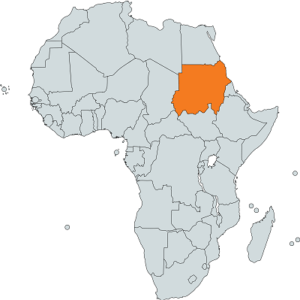
Roots of the Crisis - Sudan
National identity in Sudan, Africa’s largest country, has always been a contentious issue. Sudan suffered both a difficult colonial history and a series of governments that have held power by exploiting Sudan’s religious and ethnic diversity. As a result, Sudan has been at war for most of its recent history. The country’s most significant conflicts have been between the north and south. A first civil war lasted from 1955 to 1972, and a second from 1983 to 2005. In addition, since 2003, a genocide has been occurring in Darfur, the western-most region of Sudan. The genocide in Darfur and the increasingly dangerous situation in southern Sudan are best understood as products of the same evil: the divide and rule policies of the political elites in the capital of Khartoum. Omar al-Bashir and the elites in the Northern capital continue to maintain disproportionate power and benefit at the expense of the marginalized populations in the country’s periphery.
From the Colonial Era to Civil War
The loose Ottoman-Egyptian colonial government in what is now Sudan collapsed in the 1880s, after a national-religious revolt led by an Islamic Mahdi, or prophet. Anglo-Egyptian forces captured Khartoum in 1898 and established a jointly-administered government. The British administered the north and south separately until 1947, when the regions merged and political power was given to northern elites. Sudan gained independence nine years later, in 1956.
A year prior to independence, Southern army officers mutinied against the north, eventually leaving to form the Anya-Nya guerrilla movement. A number of northern-dominated governments rose and fell over the next several years, with General Gaafar Nimeiri leading a successful coup in 1969. Nimeiri came to power as a socialist, recast himself as a moderate, and then adopted the mantle of Islamic nationalism. As a series of coup attempts left him politically isolated, he began to seek peace not only with former adversaries in neighboring Ethiopia and Uganda, but also with rebels in southern Sudan. The Addis Ababa peace agreement was signed by the Nimeiri government and the Anya-Nya in March 1972. The accord included provisions for Anya-Nya forces to be integrated into the national army and limited autonomy for the south.
Consistent violations of the agreement by the government eventually rekindled the war. The agreement was unconstitutionally revised by the government of Khartoum in 1977, and northern troops were deployed to the oil-rich southern town of Bentiu. In response, southern troops mutinied against the government in June 1983. Khartoum then imposed Islamic (or "sharia") law in September 1983, further alienating the largely non-Muslim population of the South.
Garang, Bashir and the Second Sudanese Civil War
Southern grievances eventually crystallized around the Sudan People’s Liberation Army/Movement, or SPLA/M, a rebel group led by Dr. John Garang. As political tensions rose in the north, the economy slumped and the war in the south escalated. In the midst of seemingly-promising discussions between the government and southern rebels, the National Islamic Front (or NIF) led a bloodless coup in the North. This June 1989 power-grab effectively destroyed any hope of a peace agreement between the North and South for the next 15 years.
Led by General Omar al-Bashir, the NIF unraveled peace efforts, revoked the constitution, banned opposition parties, and intensified the war with the SPLA by declaring a jihad, or holy war, against the mostly non-Muslim south.
Though its cause gained greater attention at home and abroad, the SPLA was weakened in 1991 by two factors: first, the fall of a key regional ally, the Marxist regime of Mengistu Haile Mariam in Ethiopia; and second, by a major split within its own ranks. This led to serious inter-ethnic fighting in the south, which the government in Khartoum hoped to exploit and deepen as part of a growing ‘divide and rule’ strategy toward its opposition. The SPLA survived through a series of alliances with northern opposition movements and strong regional support. Over time, Eritrea–which had a falling out with Khartoum over the NIF’s support for Eritrean Islamic insurgents–became an important base of operations.
Around this same time, Sudan was implicated by both Ethiopia and the United Nations Security Council for involvement in the assassination attempt on Egyptian President Hosni Mubarak. The attempt took place during his visit to Addis Ababa for an annual Organization for African Union summit in June 1995. Subsequently, Ethiopia increased its support for the SPLA. Khartoum also gained notoriety for harboring Osama bin Laden and a broad array of terrorist groups throughout the 1990s. This led to further international isolation, culminating in the U.S. cruise missile attack on Khartoum following the terrorist bombings of U.S. embassies in Kenya and Tanzania in 1998.
The Comprehensive Peace Agreement
On-and-off negotiations between the government and the SPLA, under the Kenyan-led regional regional Inter-Governmental Authority on Development, made little progress from 1994 to 2001. But in 2002, the Machakos Protocol was enacted, providing the framework for future, successful negotiations. It granted the south the right to a referendum on self-determination following a six-year interim period and dictated that sharia law would remain in force only in the north.
IGAD worked closely with the United States, UK, Norway, and Italy to press the government and SPLA to reach a final deal. High-level U.S. diplomatic engagement, notably the White House’s appointment of former Missouri Senator John Danforth as special envoy, provided much needed leverage to move the process toward its conclusion.
The Comprehensive Peace Agreement, or CPA, was officially signed on January 9, 2005. The CPA initially had sufficient momentum to survive the death of SPLM leader and Vice-President elect John Garang. By October 2005, a new constitution had been ratified, a new government sworn in (with 52 percent of the executive posts for the ruling National Congress Party, or NCP, and 28 percent for the SPLM), and the south’s autonomous legislature and government became operational.
Genocide in Darfur
Darfur emerged as Sudan’s next crisis when two rebel groups, the Sudan Liberation Army/Movement (SLA) and the Justice and Equality Movement (JEM) took up arms against the government in February 2003. The rebels claimed years of political, economic and social marginalization in the region, and hailed primarily from the African Fur, Zaghawa, and Massaleit tribes.
After a string of rebel victories in the spring of 2003, the government responded by arming Arab Janjaweed militia. This allowed the militia to ‘clear’ the villages and towns of those accused of supporting the rebellion. Janjaweed tactics, directly backed by government security and intelligence forces, were brutal, and often directly targeted civilian populations rather than rebels. Village after village was burned to the ground as inhabitants were killed or fled. Despite intermittent peace talks and the presence of a 7,000-strong, but largely ineffectual, African Union protection force that was deployed in August 2004, violence and broken ceasefires continued throughout 2004 and 2005.
Divisions between and within the JEM and SLA rebel groups have exacerbated the conflict and hindered negotiations. However, it is clear that the scorched-earth strategies adopted by the Sudanese government and its militia proxies are largely responsible for the hundreds of thousands who have died in Darfur, and the roughly 2.5 million people who have been driven from their homes and now rely on humanitarian assistance for their survival. In March 2005, the UN Security Council referred the situation in Darfur to the Chief Prosecutor of the International Criminal Court for investigation, though the Sudanese government continues to oppose ICC involvement.
Peace talks mediated by the African Union culminated in the Darfur Peace Agreement on May 5, 2006. However, only one of the main rebel factions—the SLA faction led by Commander Minni Arkou Minnawi—signed the deal with the government, and the non-signatory rebel groups vowed to fight on.
Since the signing of the agreement, Khartoum has continued to support the Janjaweed militias and their attacks on civilians. Humanitarian relief in the regions is extremely poor, as relief workers are targeted by government-supported militias, rebel groups, and bandits. The partial deployment of UNAMID—the AU/UN “hybrid” peacekeeping force— in 2008 has been unable to meaningfully protect civilians in Darfur. The July 14, 2008 request by the Chief Prosecutor of the International Criminal Court, Luis Moreno-Ocampo, for an arrest warrant against Sudanese President Omar al-Bashir was a welcome step towards accountability for genocide, war crimes, and crimes against humanity in Darfur. In November 2008, the Chief Prosecutor also called for charges to be brought against members of a rebel splinter faction for their attacks on peacekeepers in September 2007.
Although the UN General Assembly and UN Security Council have endorsed the doctrine of the “responsibility to protect” civilians when their own governments are unable or unwilling to do so, the world has yet to act to protect Darfur’s civilians, ensure a lasting peace, or hold the perpetrators accountable.
Bashir and the ICC
On March 4, 2009 the International Criminal Court, or ICC, issued an arrest warrant for President Omar al-Bashir. It is a historic action which marks the first time that the tribunal has acted against a sitting head of state. Bashir is charged with crimes against humanity and war crimes and is accused of being a co-perpetrator in government-directed attacks against Darfur’s civilian population.
Bashir immediately reacted to the announcement with defiance and anger. He denounced the court's decision and, acting through the Humanitarian Aid Commission, or HAC, revoked the registrations for key international humanitarian organizations working in Darfur and throughout Sudan. The affected organizations were important providers of life-saving humanitarian services, such as water, food, health and sanitation. Their departure has had a serious effect on the humanitarian and security situation, particularly in Darfur and transitional areas between north and south.
While international human rights groups and many western nations, including the United States, praised the ICC for its decision to issue the warrant, it has generated a wealth of anti-ICC sentiment in Africa and the Middle East. Following the ICC’s announcement both the African Union and the Arab League condemned the court’s actions, arguing that the ICC is only interested in prosecuting African leaders and that the move would complicate efforts to reach a peaceful settlement to Sudan’s conflicts. Both groups have requested that the UN Security Council consider suspending the warrant. Meanwhile, Bashir continues to defy the ICC by traveling to friendly neighboring African and Arab countries, including Egypt, Eritrea, Ethiopia, and Zimbabwe.
Implementing the CPA and the future of Sudan
While the CPA was intended to be a cornerstone of peace in a country shattered by conflict, it has been hampered by the NCP’s intransigence, the SPLM’s growing pains and the international community’s neglect.
The genocide in Darfur diverted international focus and funds away from implementation of the agreement, and the international community has been slow to respond to the sputtering pace of implementation and the NCP’s attempts to undermine the CPA. The Bush administration, which had played a lead role during CPA negotiations, was unable to harmonize competing objectives in Sudan: implementing the CPA, ending the genocide in Darfur, and maintaining its close ties with the Sudanese government on intelligence sharing and counterterrorism. As a result, the U.S. has failed to give the CPA due attention and support.
The U.N. Security Council also lost capital and leverage as a credible international guarantor by failing to follow through on threatened sanctions for human rights abuses in Darfur. Emboldened by the example set in Darfur, the NCP saw little risk in obstructing implementation of any CPA provisions that did not serve their political interests. Constrained by a narrow mandate and limited capacity, the 10,000-strong United Nations Mission to Sudan, or UNMIS, has often been relegated to the role of a spectator in the south.
Yet implementation has staggered forward. While the national elections required by the CPA were postponed from July 2009 to April 2010 they have not been canceled. The elections are seen as essential for avoiding the outright collapse of the CPA. Yet recent events in Sudan highlight the uncertainty facing this process. There are concerns about the census upon which the national power-sharing proportion are based, about the ability to hold free and fair elections in Darfur and the reality that much of Sudan remains plagued by pervasive insecurity. Clashes continue in Darfur and southern Sudan. This instability and violence threaten to undermine the upcoming elections and have worsened tensions between the NCP and the SPLM.
Over the next two years a range of issues–including the elections, the ICC, border demarcation, Abyei, and the referendum on southern independence–will all test the resolve of the parties and the strength of the agreement. A fresh infusion of international commitment is needed to help navigate these challenges or the CPA may become a missed opportunity, with tragic consequences for Sudan and the entire region. The United States took a first step towards more active involvement with the appointment in March 2009 of retired Major General Scott Gration as the U.S. Special Envoy to Sudan. However, it will take robust, coordinated and high-level engagement from not only the United States but all the guarantors of the CPA to help Sudan successfully implement the rest of the CPA’s provisions and help prevent a violent collapse of the Sudanese state.
Download the Roots of the Crisis (PDF, 105 KB)
