

Editor's Note: This op-ed by Enough Project Co-Founder John Prendergast orginially appeared on the Huffington Post.
In a time of deeply divided governance, Republicans and Democrats have been united in supporting U.S. efforts to help African forces bring an end to the terror sowed by Joseph Kony and his Lord's Resistance Army (LRA) militia. U.S. military advisers have trained, equipped and supported troops from Uganda, South Sudan, and Congo in their operations, and the tide is beginning to turn in the efforts to end the Kony insurgency. But the operation's success is at risk because there are large areas of Central Africa to which the forces chasing Kony have no access. My colleague at the Enough Project, Kasper Aggar, has written a compelling report about this critical gap in the overall strategy to neutralize the LRA.
The African Union (AU) is the umbrella under which regional forces led by Uganda are undertaking counter-LRA operations. Both the military and the diplomatic components of the AU mission have observed significant progress over the past six months and — with further support — have the potential to help break the access deadlock.
Key achievements include:
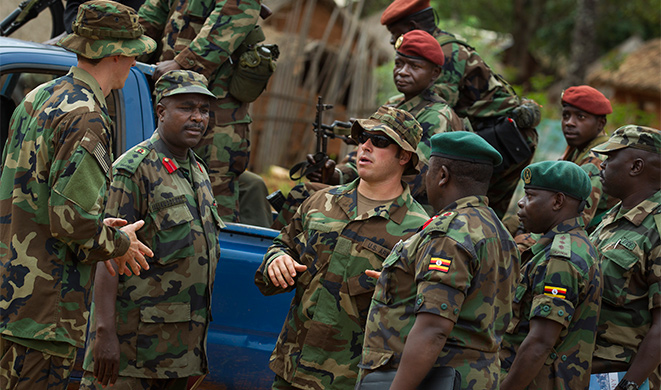
- In addition to their extensive work with the Ugandan military, the U.S. advisors have trained troops from South Sudan and DRC, and they are now undertaking offensive operations against the LRA in Congo.
- South Sudan forces have undertaken operations against LRA camps in the northern part of Garamba National Park in Congo.
- Congolese military, or FARDC, troops have pursued operations against LRA groups in the Bas Uele District in northeastern Congo. These latter two areas had been without any counter-LRA operations for up to two years.
- Diplomatic involvement by the senior AU and UN diplomats for the region helped to pave the way for access to Congo by South Sudan forces, and they helped to secure a cooperation agreement from the authorities in the Central African Republic (CAR), which allowed the operations to restart in CAR.
To maintain progress, additional support should come in the form of 1) communications assets to enable direct communication between the troops and the headquarters in South Sudan, 2) vehicles to enable ground transport of troops, and 3) an increased number of helicopters to accelerate redeployment and to carry out offensive operations and distribute defection messages simultaneously.
Read the full piece on Huffington Post.
Photo: U.S. military advisors in the Central African Republic working with regional forces in the counter-LRA mission (AP).