

The Criminalization of South Sudan’s Gold Sector: Kleptocratic Networks and the Gold Trade in Kapoeta
Read the full report. By the Enough Project team Within the area historically known as the state of Eastern Equatoria, Kapoeta is a semi-arid rangeland of clay soil dotted with short, thorny shrubs and other vegetation. Precious resources lie below this desolate landscape. Eastern Equatoria, along with the region historically known as Central Equatoria, contains some of the most important and best-known sites for artisanal and small-scale gold mining (ASM). Some estimates put the number of miners at 60,000 working at 80 different locations in the area, including Nanaknak, Lauro (Didinga Hills), Napotpot, and Namurnyang. Locals primarily use traditional mining ...
Safeguards to Peace: Steps Toward Governance in South Sudan
Download the full report. By Mark Ferullo Executive Summary Hundreds of thousands killed,[i] injured, and raped.[ii] Millions more displaced.[iii] After five years of violence in South Sudan, the peace agreement signed in September 2018 is a hopeful attempt to end the corruption-fueled war. [iv] But this is an uncertain time in South Sudan. The overall commitment to the peace agreement is low and implementation of some key provisions of the agreement has stalled completely. At the same time, President Salva Kiir continues to control South Sudan’s violent kleptocratic system of government that has deliberately constructed an infrastructure for corruption and ...
A Hijacked State: Violent Kleptocracy in South Sudan
Download the full report. By Brian Adeba and the Enough Project Team Executive Summary On September 12, 2018, the South Sudanese government and the armed opposition signed a peace deal that could potentially end the 5-year-old conflict, if elites exercise the political will required to implement the agreement. The South Sudanese conflict is rooted in the violent kleptocratic system of governance that the ruling Sudan People’s Liberation Movement (SPLM) began building in 2005, after the end of the Second Sudanese Civil War (1983–2005). When President Salva Kiir became the chair of the SPLM and the leader of the autonomous Government of ...
Sudan’s Self-Inflicted Economic Meltdown: With a Corrupt Economy in Crisis, the Bashir Regime Scrambles to Consolidate Power
Download the full report. العربية On September 9, 2018, 18 months into one of Sudan’s worst economic crises, President Field Marshal Omar al-Bashir dissolved the Government of National Consensus that took office in May 2017 and appointed a new prime minister, declaring this a first step toward the implementation of sweeping reforms to permanently heal the economy. The new prime minister, Mutaz Musa, stated shortly thereafter that his cabinet would have “400 days and 3,000 hours” to accomplish the task ahead of the 2020 “political horizon,” a thinly disguised reference to the presidential elections slated for that year, in which ...
Prolifération II: La frénésie du pouvoir et les guerres d’influence aux origines de l’escalade des violences sectaires en République centrafricaine
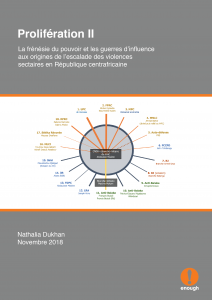
Cinq après le déclenchement de la guerre en République centrafricaine (RCA), le dénouement du conflit semble lointain ...
Splintered Warfare II: How Foreign Interference is Fueling Kleptocracy, Warlordism, and an Escalating Violent Crisis in the Central African Republic
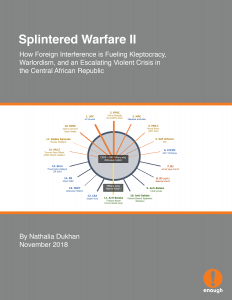
Download the full report By Nathalia Dukhan Executive Summary Five years after war broke out in the Central African Republic (CAR), the conflict has no end in sight.[i] The country has become ungovernable over time and is sinking into a structural crisis. Despite being branded a low-intensity conflict, it is brutal and bloody. Entire communities are regularly targeted in carefully orchestrated military operations. Politico-military groups and various armed factions that effectively rule the country are held responsible for the chaos.[ii] Since 2014, the proliferation of these armed groups across the country[iii] has confirmed how deeply rooted politico-criminal entrepreneurship has become ...
Powering Down Corruption: Tackling Transparency and Human Rights Risks from Congo’s Cobalt Mines to Global Supply Chains
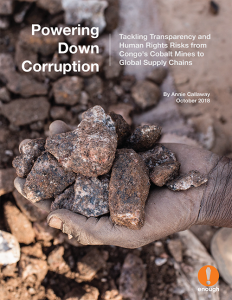
Download the full report. Résumé analytique et recommandations By Annie Callaway Executive Summary The copper and cobalt industry in the Democratic Republic of Congo (Congo) has become “a cash cow for those in power in Kinshasa and their acolytes here in the [Lualaba] province,” a miner at a cooperative in Kolwezi city told the Enough Project in February, 2018. “It’s millions and millions of dollars that they have been reaping to fill their pockets for years.”[i] A Congolese representative from a nongovernmental organization focused on natural resource transparency further warned: “The increase in international demand for cobalt is likely to ...
Why We Support Escalated Financial Pressure and Consequences: An Open Letter to the South Sudanese People
Download the full letter here. From John Prendergast and Brian Adeba October 2018 To the People of South Sudan, We at the Enough Project are deeply concerned about the flaws in the signed peace agreement that fall short of addressing the root causes of the conflict in South Sudan in a comprehensive manner that will prevent a return to conflict. We are writing this open letter to explain why – even after a peace deal was signed on September 12 – we continue to advocate for escalating and targeted financial and legal measures against those who are looting South Sudan’s ...
Neo-Colonialism and a Faustian Bargain Undermine South Sudan’s Peace Deal
Read the full report. By John Prendergast and Brian Adeba Peace remains elusive in South Sudan. The latest in a line of peace deals – this one signed on September 12, 2018 between the South Sudan government and opposition – does not address the primary root cause of the war: the hijacking of governing institutions and the creation of a violent kleptocratic state that enriches senior officials and their commercial collaborators while doing nothing to provide social services, build infrastructure, create transparency, introduce accountability, reinforce the rule of law, or grow the economy of South Sudan. Fueling this ongoing strife ...
Tools of Trade
Tools of Trade: U.S. Sanctions Regimes & Human Rights Accountability Strategies By: International Corporate Accountability Roundtable and the Enough Project Read the full report here. Economic sanctions provide financial and diplomatic pressure to further U.S. foreign policy goals and national security interests. By targeting individual actors, economic sectors, or an entire foreign government, sanctions are an attractive alternative to softer diplomatic options and drastic military action for the U.S. government to act upon its positions before the international community. Because sanctions are a malleable tool that can be tailored to specific situations, their use has risen to address a wide ...
