

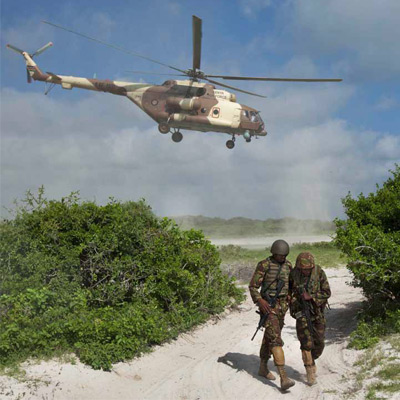
It has been almost 15 years since Somali militias shot down two U.S. Black Hawk helicopters over the capital Mogadishu and killed 18 American servicemen in a battle that also killed more than 1,000 Somalis. Since that fateful day in 1993, which had followed decades of American involvement that contributed directly to Somalia’s brokenness, the United States has largely turned its back on the fate of t he Somali people. U.S. involvement has been rooted in counter-terrorism efforts in which the suffering of the Somali people has barely been factored beyond the sending of humanitarian band-aids to cover gaping human rights wounds. The crucial requirements for reconstructing a state—which are the basic elements, on paper, of U.S. counter-terrorism policy—have received little beyond rhetorical support.
Somalia, a failed state marked for nearly two decades by conflict and humanitarian crisis, is poised at a crucial crossroads—between a further descent into an ever more intense civil war and likely famine or an opportunity to reverse the decline through a transparent process of negotiations and internationally-supported state reconstruction. Just as the Somali insurgency is intensifying, a possible window of opportunity has swung open in the form of an offer by the Prime Minister of the embattled Ethiopian-backed Transitional Federal Government[1] for a power-sharing agreement to end the war. This is the first real sign of flexibility from an entity that until now has ruled by exclusion and divisiveness.
The cost of failure is exceedingly high. Fighting this past week between Ethiopian troops and Islamic militants in Mogadishu killed at least 81 people and injured more than 100. In one instance, Ethiopian troops seized control of a mosque and, according to news reports and observers on the ground, massacred ten people inside, including 6 members of a Muslim sect not involved in the conflict. The situation on the ground is at its worst since 1991, and UN humanitarian officials warn that Somalia is heading toward a, “massive, massive crisis.”
If the international community quickly fills the peacemaking vacuum by supporting a process for real dialogue, then Somalia may have a chance to end its long and costly war. If it does not, the insurgency will expand further and the human rights and humanitarian crisis will deepen, strengthening an Islamist movement that could pose a grave regional and international threat.
The Horn of Africa is home to not just one of the worst humanitarian crises in the world today, but two: Somalia and the Ethiopian Ogaden region. A third crisis is looming in the form of a potential return to war between Ethiopia and Eritrea. Like the catastrophe in Darfur, the Somali crisis has been characterized by massive abuses against civilians, collective punishment, cleansing of entire communities, and obstruction of relief efforts. Since Ethiopian forces invaded Somalia in December 2006 with U.S. support, roughly one-third of Mogadishu—home to 1.5 million people before the fighting—has been destroyed and an estimated 60 percent of the city’s inhabitants—nearly 700,000 people—have fled. Thousands have been killed.
Across the border, Ethiopia has conducted a scorched earth campaign and imposed an economic embargo on much of the Ethiopian Somali region (known as the Ogaden). Aid agencies warn that insecurity and government obstructions in both Somalia and the Ogaden are preventing them from reaching those most in need: Together, nearly 3 million ethnic Somalis in the Horn of Africa are said by the United Nations to be at risk.[2] This report will focus on Somalia, and a future ENOUGH Project report will address the Ogaden.
There is little international awareness or action on behalf of war-affected Somalis. On the contrary, a small A.U. force in Mogadishu is supposed to protect the government, not the population. Instead of denouncing war crimes and other violations of international humanitarian law, the United States and other Western governments have shielded their perpetrators. Fundamental human rights and the international “responsibility to protect” principle have been sacrificed on the altar of counter-terrorism, but in so doing, U.S. engagement in Somalia is actually fostering the rise of Islamist radicalism across the region and playing into the hands of extremists.[3]
Just as in Iraq, a purely military solution will not yield the desired result. A sustained, internationally-driven peace initiative, coinciding with a negotiated withdrawal of Ethiopian forces and reinforcement of the A.U. peacekeeping force, must be mounted to achieve a political accommodation between the Ethiopian-backed transitional government on the one hand and the Islamist insurgents and disaffected clans on the other. Such an international peace effort should involve an organized mechanism of support for the initiative of U.N. Special Representative Ahmedou Ould-Abdallah, with formal backing of the African Union, the Arab League, the European Union, and the United States. Given its long history of involvement and influence with key regional actors and Somalia itself, America has a responsibility to play a central role.
To provide leverage to peace efforts, the U.N. Security Council should:
• Impose targeted sanctions against any Somali leader clearly fomenting further violence and the small percentage of the Somali diaspora that is financing the fighting
• Establish a commission of inquiry to investigate violations of international law
• Refer the case of Somalia to the International Criminal Court for investigations into war crimes and crimes against humanity. Until the cycle of impunity is ended, there will be no hope for peace in Somalia.
At this juncture, debate should not focus on sending further international forces—either from the African Union or United Nations—to Somalia. They would end up as cannon fodder for the competing armed groups. Now is the time to establish a significant peace process and to begin to create accountability measures. Only then would peacekeeping troops potentially play constructive protection and stabilization roles in Somalia.
Finally, there must be an aggressive response to the developing humanitarian crisis in Somalia. A famine is in the making in Somalia that might be as deadly as the 1991-92 famine that triggered the U.S. intervention and led to a third of a million deaths. The humanitarian response cannot be a substitute for political action, but it must occur on parallel tracks with the peace effort, or else hundreds of thousands of Somalis could perish.
Countering Terrorism or Promoting It?
Since late 2006, the crises in both Somalia and the Ogaden have escalated to alarming levels of violence. In this volatile region, the U.S.-led “Global War on Terror” has become intertwined with Ethiopia’s own response to regional and internal threats. When Islamists established a foothold in southern Somalia in mid-2006, Ethiopia began planning an invasion aimed at propping up a fragile and unpopular transitional government in Mogadishu. With encouragement from the Bush administration, Ethiopian forces attacked in December 2006, and 16 months later they are hunkered down with no end in sight. To make matters worse, neighboring Eritrea’s support for insurgents in Somalia and oppositionists in Ethiopia means that Somalia is further complicated by a proxy war between Ethiopia and Eritrea, one that could contribute to a disastrous resumption of war between those two states.
The United States is concentrating most of its energies on capturing or killing three foreign Al Qaeda fugitives and a dozen or so of their Somali associates. U.S. support includes a vast and sustained intelligence effort, support for self-interested Somali “counter-terrorism” agencies, and obstruction of international efforts to broker a ceasefire and power-sharing agreement with Islamists.
The crisis in the Horn is complex and deeply rooted.[4] There are no easy solutions or quick fixes. But U.S. engagement to date has aggravated it and frustrated international efforts to find a solution. Washington has made three critical errors:
• Aligning itself so closely with Ethiopia, Somalia’s historical nemesis
• Backing a narrow, corrupt, and incompetent Somali transitional government
• Providing Somali Islamists the opportunity to cast themselves as nationalists and liberation fighters, deepening their legitimacy and broadening their appeal.
On this last point, U.S. counter-terrorism policy has failed to differentiate organic resistance movements in Somalia and elsewhere from real terrorists. By branding all resistance “terrorism” and providing aid to factions of the Somali transitional government that are simply warlords with titles, the United States has contributed to further polarization and made a political settlement less likely.
U.S. policy since 9/11 has been a central ingredient in the Horn of Africa’s descent into crisis and the growth of extremism. Concerned that Somalia might become a safe haven for Al Qaeda and a breeding ground for Islamist extremism, the United States has designated Somalia as a priority in the Global War on Terror. But not only have U.S. counter-terrorism efforts failed to mitigate the threat in any sustainable way, they threaten to blow it out of all control. By placing the desire to capture or kill three “high value” Al Qaeda targets above the welfare of millions of Somalis, the United States and its Ethiopian allies have engendered profound resentment, promoted radicalization, and created the conditions for thousands of young radicals to turn toward extremist groups.
The Somali transitional government’s enthusiasm for counter-terrorism reflects a cynical—and so far successful—effort to obtain American political and financial backing against domestic rivals. At the same time, it exacerbates divisions within this transitional administration by strengthening President Abdullahi Yusuf and his security establishment, who advocate a military solution to the conflict, over Prime Minister Nur Adde and his supporters, who advocate dialogue and a negotiated settlement with the opposition. So far, U.S. and Ethiopian support to the transitional government has done more to reinforce Yusuf’s authoritarian, clan-based dictatorship than to advance broader counter-terrorism objectives.
Somalia: Epicenter of a Regional Crisis
In December 2006, Ethiopian forces launched a cross-border intervention into Somalia, routing the forces of the Council of Somali Islamic Courts[5] in a matter of days. The United States was initially a silent partner in the operation. The U.S. State Department had been quietly encouraging Ethiopian military intervention for some time, American intelligence was made available to the Ethiopian military, and covert Special Forces units joined Ethiopian forces on the ground. Just days into the invasion, U.S. forces adopted a more overt posture, conducting two air strikes against suspected Al Qaeda targets near the southern port of Kismayo.
Hauntingly similar to Iraq, the intervention was immediately hailed in Addis Ababa and Washington as a triumph over a potential terrorist threat. But key Al Qaeda and Somali jihadist leaders remained at large.[6] Suffering heavy losses, the Courts’ forces were dispersed rather than defeated, surviving to re-organize and fight another day. A broad cross section of Somali society, galvanized by foreign occupation of their country, rallied to support the resistance forces. The Islamists had a new recruiting tool: resistance against foreign aggression by Ethiopia and the United States. The invaders’ early successes gave way to a bloody insurgency. Ethiopian and Somali transitional government forces destroyed parts of Mogadishu in their mission to “save” it: Much of the already war-torn capital was completely leveled in the fighting, and close to a million Somalis were driven from their homes over the past year and thousands more killed.
By January 2008, the Courts and allied resistance groups had recovered much lost ground. Opposition forces enjoyed freer rein across southern Somalia than the Somali transitional government and its Ethiopian allies. The Islamist jihadist movement has grown exponentially since, most of its leaders remain at liberty, and its support base has been enlarged and radicalized far beyond its size in late 2006 when the Ethiopian intervention was launched. And in spite of U.S. and Ethiopian counter-terrorism objectives, the threat of terrorist actions linked to Somalia has actually increased. In March 2008 the U.S. State Department designated Somalia’s “Shabaab” militia as a Global Terrorist Entity, a move that has made the possibility of peace talks more difficult. One year after Ethiopia’s intervention, outgoing Peace and Security Commissioner for the African Union, Ambassador Said Djinnit, warned that Somalia was emerging as the continent’s biggest security challenge.[7]
Costly Policy Mistakes
Since December 2006, U.S. engagement in Somalia has been virtually indistinguishable from Ethiopia’s. Both countries have legitimate security concerns in Somalia, but these concerns are not identical, nor does Addis Ababa’s solution to them merit such unconditional U.S. support. Washington and Addis Ababa are in fact fighting two different wars with very different objectives.
Despite repeated claims of victory by Ethiopian and Somali transitional government officials, talk of an Ethiopian withdrawal has been shelved indefinitely. In a February 2008 interview, transitional government President Abdullahi Yusuf announced that Ethiopian forces would stay in Somalia until security had been fully restored—a remote prospect under present circumstances.
A further problem in hitching U.S. policy to Ethiopia’s is that Ethiopia has historically been perceived as Somalia’s principal adversary, and is still seen that way by many Somalis. The two neighbors have fought two wars, had innumerable border clashes, and the frontier between the two countries remains a provisional boundary rather than a legal border. Most Somalis still believe that Ethiopia remains more a rival than a partner, and they believe Ethiopia seeks to ensure that Somalia remains weak and divided, incapable of ever repeating its previous efforts to annex the Ogaden. From this perspective, the presence of Ethiopian forces in Somalia is little different from expecting Syria to impose an enduring peace in Lebanon or Israel to dictate a solution in Palestine. Far from “stabilizing” Somalia, Ethiopian intervention has pushed the country’s protracted conflict from a simmering regional problem into a full-blown international crisis.
Perhaps most importantly from Washington’s point of view is that the United States has gotten caught up in some of Ethiopia’s own policy objectives, which thrust the United States directly into the dynamics of regional conflict in the Horn of Africa. Ethiopia seeks to counter the influence of Eritrea, which is supporting the insurgents in Somalia in a cynical move to strike at Ethiopia through proxy forces, and to combat Ethiopian rebels who have long used Somalia as a rear base.[8] Addis Ababa’s methods have featured scorched earth tactics which have the unintended consequence of helping to build public support both for Ethiopian rebel groups and for the jihadist networks that most concern the United States.
The Somali Transitional Government: Rewarding Bad Behavior
Since 2004, international hopes for a solution in Somalia have hinged upon the Somali transitional government: a feeble, faction-ridden, corrupt and incompetent interim government. Such a policy was doomed from the start: The transitional government was conceived as an Ethiopian proxy, dominated by Addis Ababa’s allies and dependent on Ethiopian military support for its very existence. Addis Ababa’s choice for transitional government president, Colonel Abdullahi Yusuf Ahmed, was a veteran warlord with little support throughout much of Somalia. Likewise, the sole qualification of former Prime Minister Ali Mohamed Gedi—a veterinarian with no political experience—was his close ties to the Ethiopian government. Unlike Yusuf, Gedi was no warlord—his supporters billed him as a representative of Somali “civil society”—but his actions were little different than other warlord/officials.
Pinning the hopes for Somalia’s future on such leaders was not only misguided—it was reckless. Both men immediately appointed clan relatives and political sycophants to their entourages. Instead of building a government of national unity, capable of reconciling the country, they appointed a cabinet of factional allies and prepared to impose their authority by force. Lacking internal cohesion, popular support, or troops, however, the transitional government remained in exile in Nairobi for over six months until forced out by an impatient Kenyan government.
Most damaging to the transitional government’s prospects were two popular conceptions: that it was an Ethiopian puppet and that it was a platform for the interests of President Yusuf’s Majertein clan. President Yusuf reinforced both perceptions when, just days after his election as interim president, he flew to Addis Ababa and called for the deployment of 20,000 foreign troops to accompany his new government back to Somalia. His declaration proved deeply controversial even within his own government, splitting it into two rival camps. One faction, headed by Speaker of Parliament Sharif Hassan, headed to Mogadishu, while President Yusuf and his allies based themselves in the southwestern town of Baidoa, protected by a cordon of Ethiopian troops.
Meanwhile, the senior ranks of the army, police, and intelligence services—largely paid for with foreign aid—were stacked with Yusuf’s clan allies. Leadership of the National Security Agency, Anti-Terrorism Unit, and regional military commands were reserved for members of Yusuf’s Majertein clan. The presidency began to look like a family business, with virtually all senior posts, including most presidential advisors, the commander of the bodyguard, cashier and spokesman—to name but a few—drawn from the president’s closest clan relatives or his immediate family. To most Somalis, such blatant cronyism reeked of the defunct Cold War-era dictatorship of General Mohamed Siad Barre, which had been overthrown for behaving in precisely the same way.
Time after time, opportunities were missed to foster dialogue between the transitional government and those not represented in it, particularly the Islamist elements. This was the central failure of U.S. counter-terrorism policy in the Horn, a failure shared by the Ethiopian government. There never was a serious, sustained effort at brokering a power-sharing deal between the transitional government and the influential Islamists.
Strengthening Somalia’s Jihadists
To the United States, the transitional government’s patent shortcomings took second place to its enthusiasm for its counter-terrorism paradigm. Nearly a year and a half after its formation, the transitional government remained paralyzed by infighting, physically divided and politically isolated. But its real problems began in February 2006, when a group of Mogadishu-based faction leaders announced a coalition named the Alliance for the Restoration of Peace and Counter Terrorism. Essentially a U.S.-backed initiative intended to step up efforts to apprehend suspected Al Qaeda figures in Somalia, the formation of the Alliance raised alarm bells with the dozen or so Islamic Courts operating in the city—some of whose militias had indeed been protecting members of a foreign Al Qaeda cell. The Courts responded immediately with pre-emptive attacks on key members of the Alliance. Forced to choose between unpopular faction leaders and the Islamists, who had earned a reputation for enforcing law and order in the anarchic and dangerous capital, much of the Mogadishu business community and public threw its support behind the Islamic courts. By June 2006, the Alliance had been thoroughly routed and the Courts were in full control of the capital. Washington’s attempts to contain Somalia’s jihadists had backfired.
The dramatic rise of the Courts had taken the international community by surprise. Between June and December 2006, they evolved into the most powerful political and military force in southern Somalia. For the first time since the collapse of the Somali government in 1991, Mogadishu and its environs experienced peace and security. Freelance militias and their battlewagons were removed from the streets, roadblocks were dismantled, and owners could reclaim looted houses and property. It was a period that many Somalis today look back on with nostalgia as a peaceful interregnum. This was the biggest moment of opportunity lost. Had Ethiopia, the United States, and other regional powers focused on brokering a deal between the Islamic Courts and the transitional government, the current civil war may have been avoided.
But the Courts’ achievements were viewed with alarm by much of the international community and many Somalis. The disproportionate influence of hardliners within the Courts alarmed Somalia’s neighbors and many Western countries, which feared the establishment of a Taliban-style regime with links to Al Qaeda. The Courts’ leadership fuelled these anxieties by introducing a strictly conservative version of Islamic Shari’a Law, shutting down local movie houses, outlawing parties, music and dancing, banning smoking and consumption of the mild stimulant leaf called khat.
Ethiopia had particular cause for concern about the rise of the Islamic Courts: senior Courts leaders had publicly spoken of unifying “Greater Somalia,” including the Ogaden region, under a single Islamic government; there was evidence of collaboration between the Courts and two Ethiopian rebel groups, the Ogaden National Liberation Front and the Oromo Liberation Front. And the Courts received military and political support from Eritrea—Ethiopia’s strategic adversary. Furthermore, key members of the Courts espoused jihadist ideologies and sanctioned the provision of sanctuary to a small but potent Al Qaeda cell. The threat to Ethiopia was real, but Addis Ababa vastly overstated its importance.
By November 2006, the Courts controlled most of southern Somalia. Less than a dozen miles and a token force of Ethiopian troops separated its forces from the besieged transitional government in Baidoa. Peace talks in Sudan, under the auspices of the Arab League, made little headway as both camps maneuvered and stalled for time. Hardliners on both sides favored military action over negotiations.
On December 6, 2006, the U.N. Security Council passed a resolution that would pave the way for the deployment of a regional intervention force and to exempt the transitional government from a U.N. arms embargo on Somalia that had been in place since 1992.[9] Billed as a “peacekeeping force,” the regional force was in fact a response to President Yusuf’s appeal for foreign forces to back his government against potential opponents. Essentially a U.S. initiative, many Somali and international observers perceived the resolution as an attempt to arm the transitional government and legitimize Ethiopian intervention and argued that it would only make the situation in Somalia worse. Although nominally an Intergovernmental Authority on Development initiative, only two member states—Ethiopia and Uganda—were in fact prepared to send troops. Kenya was lukewarm, and three IGAD members—Djibouti, Eritrea, and Sudan—harbored deep reservations.
Both sides made grave miscalculations. In December 2006, when Ethiopian forces launched a lightning assault across the border, the Courts’ forces near Baidoa proved no match for their superior training and equipment, and were quickly routed. In order to preserve their remaining forces and political leadership, the Courts abandoned Mogadishu and dispersed to fight another day. Declaring a total victory, Ethiopia apparently fell victim to its own rhetoric and stumbled into a quagmire.
Ethiopia’s initial intervention was a military masterstroke, luring the Courts’ forces into the open where they could be routed without damage to major towns or civilian casualties. Ethiopian Prime Minister Meles Zenawi announced in January 2007 that with “two thirds” of their objectives achieved, his forces would begin to withdraw. More than one year later, Ethiopian troops have flattened much of the capital and displaced two thirds of its population. They remain mired in a vicious insurgency and the Council of Islamic Courts is resurgent across much of southern Somalia.
Ethiopia’s principal error was to place all of its eggs in the Somali transitional government basket. A deeply unpopular and ineffective authority, the transitional government was closely identified with the president’s clan and entirely dependent on Ethiopian military support for its survival. On the other side is a diverse array of clan, nationalist, and Islamist groups, which both the transitional government and Ethiopia prefer to describe as “terrorists.” But by most estimates, there have never been more than half a dozen prominent international Al Qaeda figures in Somalia, and their supporters and sympathizers represent a small minority among opposition groups. The truth is that the various elements of the resistance are united principally by their opposition to the transitional government and their determination to eject Ethiopian forces from Somalia, not by a common ideology—Islamist or otherwise.
As these dynamics began to play themselves out in early 2007, violence escalated and it became clear that the insurgents enjoyed a significant degree of popular support. Ethiopia and the transitional Somali government attributed this to certain clans which had provided the nucleus of support for the Islamic Courts. The Ethiopian counterinsurgency strategy was essentially about making the cost of supporting the insurgents so painful that these clans would withdraw their backing. In practice, this meant targeting the neighborhoods in which they lived, mainly in the northern part of the city. Bombardment of these areas failed to distinguish between civilian and military targets, and on at least one occasion Ethiopian forces allegedly used white phosphorous to burn people out of their homes.[10]
What began as a form of collective punishment rapidly escalated into a type of clan “cleansing” as hundreds of thousands of people began to flee the capital. Key Somali transitional government leaders, including Deputy Minister of Defense Salad Ali Jelle and Mogadishu Mayor Mohamed Dhere—both from the Abgal clan—made no secret of the fact that they viewed the conflict through a clan prism and believed that the Habar Gidir should quit the capital for their “homelands” in the arid central regions.
For those who remained behind in the city, life became intolerable. The forces of the Somali transitional government—known to residents as “hyenas with boots”—raped, pillaged, and killed at will. Thousands of people were arrested and detained without charge, before being ransomed back to their relatives. Suspected opposition leaders were harassed, their houses ransacked or apprehended.[11] Opposition forces were no better: Some clan militias behaved no differently from the transitional government forces. “Shabaab” assassins, often young boys paid to fire a pistol or throw a grenade, murdered “collaborators” for crimes as petty as talking to an Ethiopian soldier or selling soft drinks to transitional government troops.
International criticism of the Somali transitional government has been muted. While non-governmental organizations (including Human Rights Watch) and even the European Parliament denounced alleged war crimes, Washington’s diplomatic support effectively shielded Ethiopia and the Somali transitional government from criticism. Under pressure to show some progress towards political dialogue, the transitional government grudgingly organized a sham “National Reconciliation Conference” to which it invited several hundred hand-picked delegates. The exercise cost donor governments over $8 million dollars, much of which was paid out to fictitious participants. An additional $8 million provided for the conference by Saudi Arabia is still unaccounted.
The Eritrean Factor
Since the 1998 border war, Eritrea has sought with growing determination to destabilize the Ethiopian government and to counter Ethiopian influence in Somalia. Support from Addis Ababa and Asmara for rival Somali groups has tempted many observers to view the crises in Somalia and the Ogaden as extensions of the Ethiopia-Eritrea war. Indeed, a proxy conflict between the two states in military and political terms has exacerbated the crisis in Somalia, but is by no means the root cause of it.
Eritrea hosts a variety of Ethiopian opposition groups and maintains military training camps for the Oromo Liberation Front and the Ogaden National Liberation Front, among others. But to pin the insurgencies in Somalia and the Ogaden on Eritrea is a misreading of both crises, and an overstatement of Eritrean influence.
During the bloody 1998-2000 war between Ethiopia and Eritrea, both sides provided support to various Somali factions, and Eritrea assisted in the deployment of Oromo Liberation Front forces via southern Somalia. A peace agreement in 2000 between the two countries appeared to signal the end of the “proxy war.” However, as the implementation of the peace deal foundered over Ethiopia’s non-implementation of an independent boundary commission’s ruling on the disputed border, so did Somalia re-emerge as an arena for the competing interests of the two countries.
With Ethiopia so heavily invested in the transitional government, Asmara directed its support to the opposition. Ironically, given its own domestic campaign against Islamist militants during the 1990s, Eritrea became the Islamic Courts’ closest ally and largest arms supplier. U.N. arms embargo monitors documented over a dozen flights from Asmara to Mogadishu, carrying arms and materiel to the Islamic Courts. When the Courts were overthrown in January 2007, Eritrea hosted its exiled leadership and sponsored the formation of the Alliance for the Re-liberation of Somalia.
Somalia’s Window of Opportunity
In March 2008, Somali transitional government Prime Minister Nur Adde announced that his government was willing to engage opposition groups in a dialogue to end the long-running civil war in Somalia and circulated a peace proposal entitled the “Reconciliation Strategy of the Transitional Federal Government of Somalia.” Around the same time, the Asmara-based opposition issued a “Road Map for Dialogue and Reconciliation of Somalia” calling for negotiations over political and security arrangements, including the withdrawal of Ethiopian troops. In subsequent encounters with Western diplomats, however, President Yusuf has signaled his objections to dialogue, insisting that military operations continue and highlighting the deep divisions within the Somali transitional government. Caught between its desire for a political solution and its counter-terrorism priorities, the United States has been a bystander to peace efforts.
The urgent priority of the international community is to put a peace process together that will allow the parties to engage and will create some incentives, pressures, and timelines to achieve the objective of a power-sharing deal to end the war.
The Special Representative of the U.N. Secretary General for Somalia, Ahmedou Ould-Abdallah, should lead a major, internationally supported initiative. Key regional states and other actors with influence—such as the United States, European Union, African Union, and Arab League— should quickly establish a working group to support Ould-Abdallah and his efforts. Time cannot be wasted, as this small window of opportunity could close quickly.
With its mandate rapidly running out of time and no prospect of military victory in sight, the Somali transitional government faces no alternative but to seek a ceasefire and political settlement with its opponents. The transitional government alone cannot lead such a process: Achieving a settlement will require third-party mediation and sustained pressure on both sides. The United States will have to work with Ethiopia in order to bring the requisite pressure to bear on President Yusuf to engage constructively in negotiations. The recent tactical shift in Ethiopian support to Prime Minister Nur Adde should be encouraged, but Ethiopia must do far more. Equally important, supporters of the insurgents will have to be included in order to bring positive pressure on that side of the equation as well.
Securing a ceasefire will have to address the opposition’s basic demand that Ethiopian troops withdraw. Ethiopia’s military presence is deepening the crisis, but precipitous withdrawal is not in the cards and could arguably cause more problems than it would resolve. Ethiopia has legitimate security concerns, and these must be fully factored into any solution. Therefore, the modalities of a withdrawal will have to be negotiated: the timing and phasing of withdrawal, agreed security arrangements to replace the Ethiopian forces, and the mandate and composition of any international force to oversee the withdrawal and cessation of hostilities.
Politically, the challenge is to articulate a road map for completion of Somalia’s transition, approval of a new constitution and replacement of the transitional federal institutions with a more permanent and representative system of government. Broadly speaking, there are two ways this might be achieved: (1) A power-sharing agreement in which the opposition joins the transitional government, forming a new transitional national unity government; or (2) Agreement between the transitional government and the opposition to establish joint mechanisms, including a constitutional commission, electoral commission, and security commission, to manage the transitional process.
In order to provide some international leverage to the talks, the U.N. Security Council should begin discussing the imposition of targeted sanctions on those Somali officials and insurgents who continue to foment violence and undercut any process that might emerge. The Security Council should also establish a commission of inquiry to investigate violations of international law (as called for by Human Rights Watch) and begin discussing a referral of the war crimes and crimes against humanity being committed in Somalia to the International Criminal Court in order to bring an end to decades-long impunity that has fueled the crisis.
Debate now should not center on the sending of further international forces—whether from the African Union or the United Nations—to Somalia. They would simply be cannon fodder for the competing armed groups. The absolute imperatives now for the international community are to establish a significant peace process and begin to create accountability measures for the war crimes that are being committed as well as for those that would continue to obstruct peace efforts. Only then would international peacekeeping troops potentially play a constructive role in protecting civilians and supporting stabilization in Somalia.
These kinds of windows rarely open in Somalia, after years of deadly conflict and anarchy. It is urgent that the world not allow this immediate window to close without fully exploring the possibilities of peace. Given its long history of involvement and its influence with key regional actors, the United States has a responsibility to play a central role if there is to be any chance for this window to open more fully toward a real solution.
(NOTE: This is the first in a series of strategy papers by ENOUGH that will explore the complex situation in the Horn of Africa. The series will examine the human rights crises in Somalia and the Ogaden, the damaging standoff between Ethiopia and Eritrea, and the roles that terrorist organizations and U.S. counter-terrorism policy play in the region. There are widely divergent views on how to interpret the facts on the ground. We hope that this series will provide readers with the chance to look at different sides of this spiraling regional crisis, and we hope that our suggestions for action will help shed some light on the way forward.)
[1] The transitional government is recognized by the United Nations, Arab League, and African Union but is the subject of great controversy inside Somalia, failing to create credible governing institutions over three years after inception.
[2] This total includes two million people in Somalia (see http://www.fsausomali.org/) and 953,000 people in the Ogaden (see http://www.wfp.org/english/?ModuleID=137&Key=179and the latest situation reports from the U.N. Office for Coordination of Humanitarian Affairs). There are three main factors contributing to rising food insecurity: an extremely harsh dry season, growing insecurity, and high inflation. See http://www.irinnews.org/Report.aspx?ReportId=77768.
[3] For more on the regional counter-terrorism dynamic, see John Prendergast and Colin Thomas-Jensen, ‘Blowing the Horn,’ Foreign Affairs, March/April 2007.
[4] A future ENOUGH report will look more closely at the roots of interlocking conflicts in the Horn of Africa.
[5] The Council of Islamic Courts had consolidated authority in the latter half of 2006 over a wide swathe of central and southern Somalia.
[6] One of three “high value” Al Qaeda targets sought by the United States, Tariq Abdulla, also known as Abu Talha al Sudani, was later reported to have died of wounds suffered in one of the American air strikes.
[7] Peter Heinlein, “African Union Unveils Road Map for Peace in Somalia,” Voice of America, January 24, 2008, accessed at http://www.voanews.com/english/2008-01-24-voa1.cfm
[8] Two such groups are the Ogaden National Liberation Front and the Oromo Liberation Front.
[9] Named for IGAD, the Intergovernmental Authority on Development, a regional grouping that includes Djibouti, Eritrea, Ethiopia, Kenya, Somalia, Sudan, and Uganda.
[10] See the Report of the UN Monitoring Group on Somalia, July 18, 2007. The report is available at http://www.securitycouncilreport.org/atf/cf/%7B65BFCF9B-6D27-4E9C-8CD3-CF6E4FF96FF9%7D/SOMALIA%20S2007436.pdf According to the website www.globalsecurity.org, “White phosphorus results in painful chemical burn injuries…Phosphorus burns on the skin are deep and painful…These weapons are particularly nasty because white phosphorus continues to burn until it disappears. If service members are hit by pieces of white phosphorus, it could burn right down to the bone.” The United States military used white phosphorous against insurgents in Fallujah, Iraq, in November 2004. See http://www.washingtonpost.com/wp-dyn/content/article/2005/11/16/AR2005111600374.html
[11] The indiscipline of the TFG forces has been acknowledged by the PM (who apologized for their actions in Bakaraha) and by the TFG Chief of Staff, Salah Liif, who called on the people of Mogadishu to defend themselves from criminals in government uniforms. See http://shabelle.net/english/2008/03/07/somali-transitional-government-should-discipline-its-forces and http://www.iht.com/articles/2008/03/28/africa/somalia.php.